Water mist has been used in fire protection for more than two decades, yet mention it to most building services engineers and the reaction is not always positive.
While some see it as a useful, well-proven alternative to sprinklers, others recall a technology that arrived with bold claims but few reliable ways of testing whether they held up.
Both impressions contain some truth, but neither fully reflects where the technology stands today. What has changed most over the past two decades is not the engineering, but the framework now in place to verify it – a distinction that deserves more attention than it currently receives.
To understand why water mist acquired a mixed reputation, it is worth considering the stringent regulatory environments from which its predecessors benefited.
Sprinkler systems, fire detection and gas suppression have all had decades of prescriptive, internationally recognised standards, reinforced by long-established third-party certification schemes that examine the competence of the companies that design and install them.
An engineer specifying a sprinkler system should be reasonably confident that any competent designer, working to the same rule book, will reach broadly the same outcome. Water mist had no equivalent when it began making its way onto the market. It grew commercially before the standards required to audit it had caught up.
That gap created problems that, with hindsight, were entirely predictable. Early water-mist suppliers frequently described their systems as ‘sprinkler equivalent’, without independent fire-test evidence to support the comparison.
Some claimed third-party certification but, on closer inspection, this often referred to a quality management certificate, such as ISO 9001, rather than any proof that the specific water-mist system had been fire-tested and found suitable for the environment into which it was being sold. As there was no harmonised set of test protocols against which such claims could be checked, specifiers, insurers and building owners had little means of separating sound engineering from confident marketing.
There was also a structural reason this proved hard to resolve. Sprinklers extinguish fire largely through water droplets of between one and five millimetres, which cover a premises in considerable amounts of water. In addition, their broadly similar mechanism allows sprinkler design rules to be applied consistently, regardless of manufacturer.
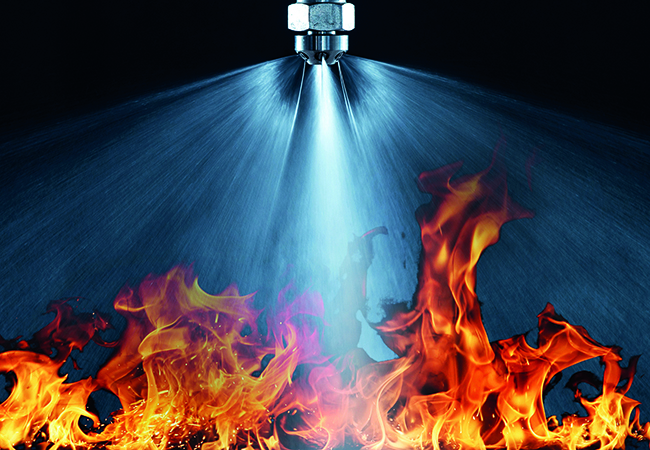
High-pressure water mist works very differently. Droplets, measuring between 50 and 300 microns – a fraction of a millimetre – convert rapidly to steam on contact with heat, drawing energy from the fire and displacing the oxygen around it, rather than wetting the space.
Because droplet size, pressure and nozzle design vary significantly between manufacturers, no two water-mist systems behave identically. Claiming equivalence, in other words, needs proof for each specific system and application, not a generic assurance that the underlying principle works. For years, the market lacked any consistent means of demanding that proof.
That position has now shifted substantially. EN 14972, a harmonised European standard for water-mist systems, was published last year. Earlier approaches, including the previous British standard and the American NFPA 750, required suitability to be proven for the application in principle, but it lacked the test protocols needed to enforce that requirement consistently.
EN 14972 runs to 17 parts: one covering design and 16 setting out full-scale fire-test protocols across ordinary and high-hazard categories and applications. Crucially, a manufacturer can no longer rely on assertion.
Suitability for a given application must now be demonstrated through full-scale fire testing against the relevant protocol. Just as significantly, the underlying design parameters – such as water supply duration, area of application or hazard classification – have been deliberately aligned with established sprinkler design parameters. These changes make meaningful, like-for-like comparison possible for the first time.
This shift is starting to be felt where it matters most. Insurers who were once instinctively wary of water mist, partly as a legacy of its earlier unregulated reputation, now acknowledge how much progress there has been in testing and certification. More than any marketing claim, that shift in professional opinion is the clearest evidence that the standards are doing their job.
Because droplet size, pressure and nozzle design vary significantly between manufacturers, no two
water-mist systems behave identically
For specifiers, this has practical implications. The first question worth asking a water-mist supplier is not whether the system is ‘sprinkler equivalent’, but whether full-scale fire-test evidence exists for the specific application and hazard category in question.
The second question is what any third-party certification covers – the design and fire performance of the system itself, or merely the supplier’s quality management processes?
The third is whether manufacturer guidance has been produced for that particular risk category. Unlike sprinkler components, water-mist systems are not interchangeable between manufacturers; design guidance from one cannot simply be transferred to another.
None of this makes water mist a universal solution. It suits situations where conventional sprinklers struggle: heritage buildings, where water damage is a serious concern; car parks, where space for large water tanks is limited; or where there is a risk of lithium-ion battery fires, which behave unpredictably. Water mist’s three-dimensional suppression mechanism, closer in some respects to gas suppression than to sprinklers, serves these niches well.
However, the same application-specific testing regime that has strengthened the technology’s credibility also means coverage remains uneven. A system proven for one configuration and hazard category cannot be assumed to extend automatically to another. The right question for specifiers, then, is not whether water mist works in principle, but whether it has been proven to work for this building, this risk and this configuration.
Water mist has been a capable technology for longer than its reputation suggests. What has finally caught up is the means to verify that capability. For an industry built on trust – between specifier, insurer and building owner – that verification, rather than residual scepticism from a less-regulated era, should be what informs decisions.
About the author
Richard King is managing director at Hall & Kay