Credit: iStock – Maksim Safaniuk
Customers on heat networks are too often faced with high heating bills. As the sector rapidly transitions away from fossil fuels, one of the biggest challenges is delivering low-cost heat using electricity – a fuel that, historically, has cost significantly more than gas on standard fixed-rate tariffs, even if that gap is expected to narrow under revised price caps.
Furthermore, with large-scale heat pumps the primary technology driving this decarbonisation, the upfront capital cost of delivering heat is rising. Those costs are ultimately borne by consumers, through heat tariffs or service charges.
Heat network design has a direct influence on operating and capital costs, and smart, holistic system design can narrow the gap significantly. Below are three ways in which design engineers can help deliver more affordable heat to consumers.
Heat pump selection and the operating model
Heat pumps are the logical choice for modern heat networks because of their high efficiency, measured as the coefficient of performance (COP). To overcome the electricity-to-gas price penalty, however, a heat pump must maintain an average COP of around three to match the running costs of a gas boiler, based on the upcoming electricity and gas price caps, and accounting for boiler efficiencies.
Heat pumps are often blamed for high heating bills, but the issue is usually not with the technology itself, but how it’s selected and applied. For heat networks, designers need to assess variables that change across the year, including ambient air temperature, heat demand profiles, network operating temperatures and electricity prices.
Leveraging the operating model
A model may be used to simulate heat network performance for each hour of a typical year. To assess heat pump performance accurately, engineers need detailed manufacturer data showing COP values against target flow temperature, the range of return temperatures and the full range of local ambient conditions.
Feeding this data into the model allows designers to forecast seasonal performance more reliably and select heat pumps that are suited to the network’s operating conditions.
Heat pump selection
Heat networks should be designed around high temperature differentials (ΔT) and low return temperatures, which reduce both heat loss and pumping energy. However, many standard heat pumps are designed for narrow temperature differentials (typically 5K), use synthetic refrigerants and operate on a constant-volume basis.
For example, if a network is designed to operate at 60°C flow and 30°C return (a 30K ΔT), using a low-ΔT heat pump means recirculating around six times the water volume through the heat pump to remain within its operating envelope. This increases pumping energy significantly and loses the opportunity to exploit lower return temperatures to subcool the refrigerant after condensation, increasing evaporator cooling capacity and improving COP.
Some manufacturers are responding by redesigning heat pump architecture. Rather than relying on a single heat exchanger, they are developing units with multiple internal heat exchangers, configured to accommodate and benefit from a wide network ΔT.
Combined with natural refrigerants such as propane (R290), this offers a lower environmental impact alternative to synthetic refrigerants and a solution better suited to higher flow temperatures and wider ΔT. Using heat pumps matched to the operating conditions of new-build heat networks, operating models estimate COPs, over a typical year, of around three. This equates to a reduction in CO2 emissions of around 90% compared with an equivalent heat network served by a gas boiler, emphasising the positive impact of decarbonisation.
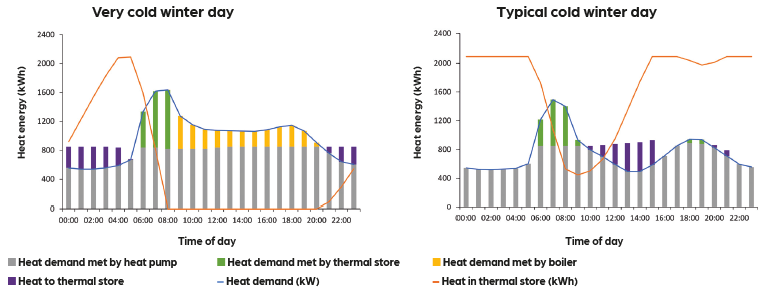
Operating model output for very cold day (left) and a more typical cold day (right)
Hybrid heat sources: optimising capital cost
Improving COP helps reduce running costs, but affordability also depends on capital cost. Industrial heat pumps typically carry a significant premium compared with simpler equipment, such as boilers, so plant strategy has a major influence on project viability and on the costs ultimately passed to consumers.
Operating models also reveal a consistent pattern in the load duration curve. Over a year, heating equipment rarely needs to operate above half of its peak capacity, particularly on residential networks serving domestic hot-water heat demand and space heating. Peak loads tend to occur only during short periods of intense, morning hot-water demand on the coldest winter days.
That creates a strong case for a hybrid heat source strategy, supported by appropriately sized thermal storage. Plant capacity can be split roughly 50/50 between high-capital expenditure (capex) heat pumps and lower-capex peak plants, such as electric boilers. Because the heat pumps continue to cover the steady, long-running base load, models indicate they can still deliver around 99% of the network’s annual heat demand.
The electric boilers then operate only to top up the system during seasonal peaks (Figure 1). This can reduce both capital cost and energy centre space requirements, with negligible impact on carbon emissions or overall network efficiency.
Thermal storage and grid balancing
Thermal storage provides a further opportunity to reduce operating costs by decoupling heat production from heat demand. It supports hybrid plant strategies by reducing reliance on peak plant, but its most significant role, economically, may be in enabling demand-side Grid balancing.
When paired with dynamic, time-of-use electricity tariffs, thermal storage allows heat networks to avoid the highest electricity prices. Under dynamic tariffs, electricity outside the evening peak (typically before 4pm and after 7pm) can fall to around 15p/kWh on average, well below standard fixed-rate prices.
Building management systems (BMS) can therefore be configured to shut down a heat generation plant during high-cost periods and instead draw on heat stored earlier in the day. To maintain service resilience, the BMS can restart the heating plant only as thermal stores approach depletion. Again, hourly operating models are critical, because they allow engineers to estimate demand during these periods and size thermal storage accordingly (Figure 2).
The value of thermal storage can be strengthened further through Grid-balancing mechanisms, such as the demand flexibility service. These schemes financially reward operators not only for reducing electricity consumption at peak times, but also for increasing consumption when excess renewable generation is available.
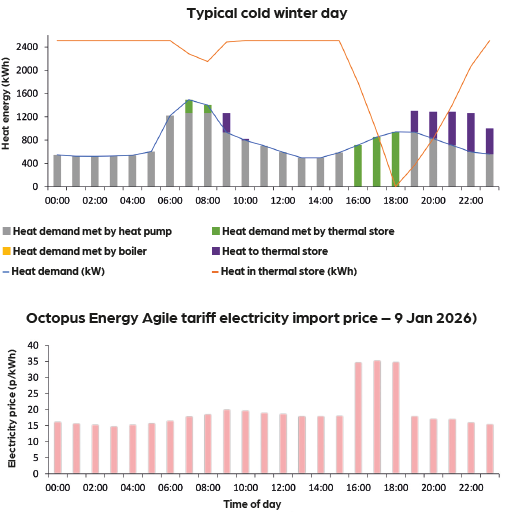
Operational model output using demand-side Grid balancing on a typical cold day
Conclusion
If a fixed electricity tariff of 26p/kWh can be reduced to an average of around 15p/kWh through off-peak heat generation, and the heat pump system delivers a COP of three over a year, heat can be generated at roughly 5p/kWh. Allowing for system heat losses, the customer cost of heat is then around 6p/kWh, which is an improvement compared with gas even before any additional value from Grid balancing.
To realise these benefits in practice, design intent must be carried through installation, commissioning and testing. Ongoing maintenance and fine-tuning, informed by close monitoring, helps maintain performance.
Using hourly operating models to select appropriate heat pumps, combining them with lower-cost peak plant, and integrating thermal storage with dynamic tariff and Grid balancing can improve affordability without compromising decarbonisation.
About the author
Adam Reeve is principal engineer at Max Fordham