

From March 2027, new homes in England need to meet the Future Homes Standard (FHS), published in March this year. They will have to be more airtight and insulated than currently required under the 2021 edition of the Building Regulations. As a result of these changes, mechanical ventilation will no longer be a choice but a necessity.
The FHS notional dwelling assumes decentralised mechanical extract ventilation (dMEV) and many housebuilders will install mechanical ventilation with heat recovery (MVHR) to improve energy efficiency.
At the same time as the transition to the FHS, the tool used to demonstrate compliance is changing. The Standard Assessment Procedure (SAP), a steady-state method working on monthly averages, is giving way to the Home Energy Model (HEM), which simulates a dwelling on a half-hour basis.
Getting wrapped by FHS
The Home Energy Model is the underlying simulation engine, while the Future Homes Standard wrapper is the set of standardised assumptions and compliance rules that govern how the model is used for regulatory assessment. As a result, some simplifications seen in compliance calculations arise not from limitations of HEM itself, but from the requirements of the Future Homes Standard methodology.
For example, the HEM engine could potentially model using data representing local weather, solar radiation, and wind conditions however, if the FHS wrapper specifies a standardised weather file for all compliance calculations, then the engine uses that file instead.
SAP remains the compliance method at the point the FHS takes effect in March 2027. HEM phases in after a minimum three-month parallel period, with both methods accepted for at least 24 months.
The obvious expectation is that a half-hourly method models homes better. However, the results from our research complicates that expectation1.
The comparison is based on The Future Home (TFH), a zero-carbon-ready house built by Bellway and tested in the Energy House 2.0 climate chamber2, University of Salford. TFH is a three-bedroom, two-storey timber-frame dwelling with multiple HVAC configurations3.
This comparison uses its dMEV setup, matching the FHS notional dwelling. SAP 10.2 was compared with the consultation version (v0.28) of the HEM FHS wrapper (see panel ‘Getting wrapped by FHS’), which divided the dwelling into two thermal zones, as SAP does, and used the Manchester weather file.
The two methods reach high agreement under steady state. Fed the same U-values, thermal bridging and air permeability from measurement, SAP and HEM return heat transfer coefficients (HTC) within 1% of each other (105.3 against 104.3 W/K). They agree on how much heat this house loses under steady-state conditions.
From the results, ventilation is another area where SAP and HEM agree. Ventilation electricity is almost identical in both tools: 52 kWh under SAP, 40 kWh under HEM, both accounting for around 2% of regulated energy. But that reading misses where ventilation fits in the energy balance.
The real difference sits in space heating: HEM’s space heating demand is around 24% higher than SAP’s, and the electricity to meet it higher still, at around 62% greater due to HEM’s timestep-level representation of the heat pump. (See Figure 1).
Figure 1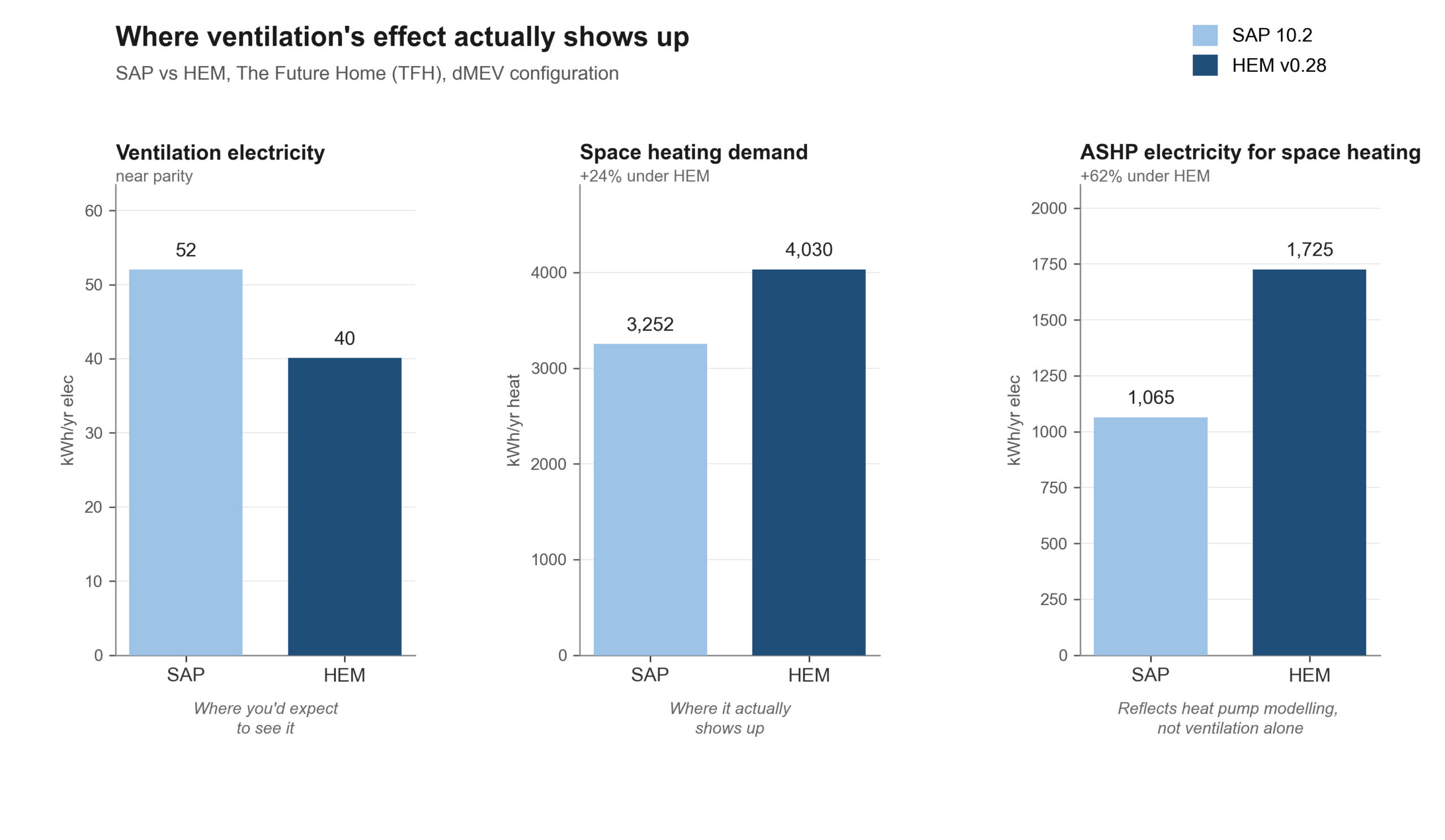
HEM’s internal gains are 7.98% higher and solar gains 26.49% higher than SAP’s; both would normally reduce space heating demand, not increase it. Part of the gap comes from assumption difference: the HEM FHS wrapper heats the rest of the dwelling to 20°C against SAP’s 18°C.
This kind of difference is visible and can in principle be normalised. What remains after normalisation points to the loss side, is a structural difference that better input data cannot remove.
Ventilation and infiltration heat loss is a result of two quantities at each timestep: air flow rate and the indoor-outdoor temperature difference. SAP calculates this from monthly averages, an effective air change rate scaled by the monthly mean wind speed, multiplied by the monthly mean temperature difference.
Key differences between SAP and HEM
| Aspect | SAP | HEM |
| Calculation basis | Monthly average energy balance | Half-hourly dynamic simulation |
| Time resolution | Monthly | 30-minute timesteps |
| Weather data | Monthly averages | Hourly/half-hourly weather series |
| Building response | Simplified steady-state | Dynamic thermal response |
| Occupancy | Standardised schedules | More detailed occupancy and appliance profiles |
| Heating systems | Seasonal efficiencies and correction factors | Explicit system operation at each timestep |
| Ventilation | Monthly-average airflows and heat losses | Time-varying ventilation and infiltration |
| Solar gains | Monthly averaged | Dynamic solar gains |
| Overheating | Separate assessment | Integrated within the model |
| Future flexibility | Difficult to extend | Designed as a platform for future developments |
HEM instead adjusts the air change rate at each timestep based on local wind speed; the current release extends this to a full pressure balance following BS EN 16798-7, which considers calculation methods for the determination of air flow rates in buildings, where wind pressure, stack effect, and the mechanical system together determine the total air change rate at each timestep.
This matters because in a UK winter, the most windy and coldest periods arrive together. When both flow rate and temperature difference rise simultaneously, the heat loss over a month is greater than what monthly averages would predict. SAP can only see the latter and better input data would not fix it.
How much of the 24% space heating gap this mechanism accounts for is not quantified here and will be included in ongoing work, but its direction is certain: it pushes SAP’s demand below HEM systematically.
For MVHR, there is a greater difference between HEM and SAP. Both treat heat recovery efficiency as a fixed input. But HEM applies that efficiency against the actual half-hourly temperature difference. It adjusts the mechanical flow rate for actual pressure conditions at each timestep, a stated departure from BS EN 16798-7 which assumes mechanical flows are fixed.
It calculates duct heat losses from duct length, insulation, and whether the unit sits inside or outside the thermal envelope. It returns half the fan electricity back to the dwelling as heat, on the basis that the supply fan warms incoming air while the extract fan’s heat leaves.
SAP represents none of these directly. It applies a fixed efficiency, using a set of in-use factors.
Because recovered heat, duct losses, and fan gains are whole-dwelling quantities, these differences carry through to the compliance figure. For MVHR, the move to HEM is a , not just a resolution change.
How the modelling affects the compliance figure is decided by the wrapper as much as the engine. The core engine can take any number of thermal zones and read any location’s weather but the FHS wrapper fixes both.
The consultation version used here divided the dwelling into two zones and used Manchester weather. The current FHS wrapper fixes the dwelling to a single zone, with air assumed to circulate freely, and applies the same standardised weather file to every dwelling regardless of location. The engine may have the capability, but the wrapper makes the simplification.
Beyond both engine and wrapper, there is one thing neither method addresses: how ventilation distributes air and heat between rooms. HEM’s engine solves ventilation for the dwelling as a whole which is a documented methodological choice and does not move air between zones.
The FHS wrapper goes further, collapsing the dwelling to a single freely mixed volume with no heat transfer between zones. Room-to-room air distribution is central to what a ventilation strategy actually does in a building, and it is absent from both methods.
Conclusions
These results point in three directions. First, where SAP and HEM differ on this zero carbon ready house, the difference is about the dynamic treatment because the two agree in steady state to within 1%.
Second, the ventilation and infiltration difference is real but embedded in the space heating gap, driven by the co-occurrence of wind and cold that monthly averaging cannot capture.
Third, for MVHR the move to HEM is an methodological improvement in ventilation modelling – it represents more of the physical mechanisms determining MVHR performance (timestep-resolved efficiency, dynamic flow adjustment, duct losses, end fan heat recovery for example), rather than approximating them through a fixed in-use factor as SAP does. However, what showed in the compliance figure is decided by the FHS wrapper as much as the engine’s resolution.
Further research
Two questions remain. The first is how the two methods compare under an MVHR configuration, where HEM’s more detailed modelling of duct losses, pressure effects, and fan energy would produce a more obvious difference.
The second concerns what both methods don’t account for: heat transfer between zones. This is being examined through a comparison of SAP, HEM, and a dynamic simulation tool applied to a glazed thermal buffer space, where the ability to transfer heat across zone boundaries is the key point determining the energy contribution.
Early results suggest the bias is systematic and directionally predictable and its extent is the subject of continuing work. Further details on the ongoing research projects are available at the Energy House 2.0 website4.
What HEM means for ventilation design
The transition from SAP to HEM is not only about finer time resolution but also moves assumptions that SAP fixes at policy level onto inputs the assessors need to declare.
Because HEM resolves wind speed and outdoor temperature together at half-hourly intervals rather than as monthly averages, it captures the covariance between wind and cold that is typical of UK winters, which SAP’s averaging method cannot.
This bias runs in one direction regardless of how airtight the dwelling is. For FHS-compliant new build, where air permeability targets are already low, the absolute effect on demand stays relatively small. The same mechanism would matter more for existing houses, where infiltration rates are typically higher and where HEM is expected to be used for EPC assessment from 2027.
SAP’s in-use factor accounts for ductwork losses only through a coarse three-way classification of duct type (rigid, flexible, or none), applied as a fixed factor regardless of duct length, insulation, or routing.
HEM calculates heat loss directly from these parameters: actual duct length, insulation level, and whether the unit sits inside or outside the thermal envelope. The decision regarding the duct design, which previously had no impact within a specific duct type category, will now result in quantifiable energy losses.
SAP applies a fixed, system-type-based in-use factor to fan power and heat exchanger efficiency by default, regardless of how well a system is actually commissioned, unless the assessor supplies measured in-situ evidence to override it.
HEM uses a different approach: specific fan power is assumed to already include any in-use derating, unless a separate factor is declared alongside it. This single declared figure, rather than a policy-mandated table, now governs how commissioning and balancing quality is reflected in the result.
ABOUT THE AUTHORS
Xinyi Zhang is a PhD Researcher and Professor Richard Fitton a technical director of Energy House 2.0 at Energy House Labs, University of Salford
REFERENCES
1 Detailed results are described in 2025 CIBSE Technical Symposium paper. ‘Comparisons between the UK Standard Assessment Procedure (SAP) and Home Energy Model (HEM) for a zero-carbon ready home.’
2 Energy House 2.0 is described in journal paper ‘Energy House 2.0: The Design, Build, Commissioning, Performance & Early Findings of a Large-Scale Building Physics Test Facility’.
3 TFH is described in Bellway “The Future Home” Baseline Performance Report.