
For an alternative way to access this module, CIBSE member, Jos Brownlie provides a video reading the module: Module 265 recording

The transition from fossil fuel heating to heat pump technology is now central to achieving net zero 2050 targets. With buildings responsible for around 36% of EU greenhouse gas emissions,1 decarbonising space heating and domestic hot water (DHW) is a key priority for building services engineers. Heat pumps offer a significant step beyond the efficiency limits of traditional gas boilers, which typically plateau at around 95%, by exploiting the thermodynamic benefits of the vapour compression cycle.
Heat pumps transfer heat from low-temperature environmental sources – such as air, ground or water – into building heating systems through the four-stage process of evaporation, compression, condensation and expansion. Rather than generating heat through combustion, they use electrical energy to move existing thermal energy, enabling coefficients of performance (COP) of up to 4.0.1
This shift also has major implications for carbon reporting under the Greenhouse Gas Protocol. Replacing gas boilers with heat pumps can eliminate direct Scope 1 emissions, while increasing decarbonisation of the electricity Grid reduces the carbon impact of Scope 2 emissions. Even at modest seasonal efficiencies, heat pumps can deliver significant lifetime carbon savings.
Modern commercial systems are typically classified as air-to-air, air-to-water or water-to-water, each suited to different space-heating and DHW applications.
Advanced engineering solutions and refrigerant selection
The thermal requirements for space heating and DHW differ significantly because of distinct end-use purposes, safety regulations and load profiles. Space-heating temperatures are dictated by building heat loss and emitter types. Underfloor heating is the most efficient match, requiring flow temperatures of only 35°C to 40°C, while fan coil units typically operate between 45°C and 50°C. Radiators require 45°C to 70°C, though larger surface areas allow for operation at the lower end of this scale. Crucially, space heating allows for weather compensation, lowering flow temperatures during milder periods to optimise efficiency.
In contrast, DHW systems have strict, consistently high-temperature requirements, driven by health and safety regulations – specifically, the need to prevent legionella bacteria. Storage systems must maintain 60°C or higher,2 while large commercial applications, such as hotels, often require up to 80°C. Unlike space heating, DHW demands do not decrease in milder weather and feature ‘peaky’ usage profiles. Although higher output temperatures can reduce efficiency as condensing temperatures approach the refrigerant’s critical point, modern commercial heat pumps increasingly overcome these limitations through improved refrigerants, compressor technology and system design, allowing stable operation at elevated flow temperatures.
Calculating DHW storage is a critical component of the design. Engineers must evaluate fixture demands and diversify them according to standards such as BS EN 806-3:2006. The physical storage vessel is sized using an hourly assessment of charging and discharging cycles. The model must demonstrate that the heat pump can recharge the store in time for peak loads and that the store is completely discharged each day to maintain hygiene. Industry guidelines, such as CIBSE Guide G, provide benchmarks, but dynamic modelling is preferred for heat pump applications, to minimise the required electrical peak.
High-temperature applications
To address the constraints of high-temperature applications for DHW and retrofits, where legacy hydronic systems were designed for 82°C/71°C cycles, the choice of refrigerant and system architecture are key considerations.
Standard synthetic refrigerants such as R32 and R454c are generally limited to 60°C and 70°C, respectively, at -5°C ambient temperature.3 Reaching higher temperatures requires specialised natural refrigerants, such as carbon dioxide (CO2), or bivalent or cascade system configurations.
Refrigerants with higher critical temperatures, such as propane (R290) and ammonia (R717), are generally better suited to medium- and high-temperature heating applications, because they maintain efficient subcritical operation at elevated condensing temperatures. This allows stable production of low-temperature hot water (LTHW) flow temperatures in the range of 65°C-80°C, supporting retrofit projects where existing terminal units may not be oversized for low-temperature operation.
By contrast, CO₂ (R744) operates using a transcritical cycle and is particularly effective where very high DHW temperatures are required. Although capable of delivering water temperatures above 80°C, system efficiency is highly dependent on return water temperatures and hydraulic design. CO₂ systems, therefore, benefit from large water-side temperature differentials and are commonly configured for dedicated DHW generation rather than general space heating. CIBSE Journal CPD module 263, ‘Transcritical CO₂ heat pumps for commercial buildings’, considers transcritical heat pump applications in more detail.
A refrigerant’s thermodynamic characteristics directly affect hydraulic strategy. Lower flow temperatures generally require increased system flowrates to maintain heat output, potentially increasing pipework sizes and pump energy. Conversely, refrigerants capable of higher temperatures may be more appropriate for retrofit applications, but can reduce seasonal efficiency if operated continuously at elevated condensing temperatures.
For many commercial applications or multi-residential developments, a cascade heat pump configuration is often the most versatile option. This involves placing two heat pumps in series to divide the total temperature lift. A primary air-source unit produces low-temperature water, which acts as the heat source for a secondary water-to-water unit. This arrangement can be used to provide high temperature DHW or to lift the supply water temperature in steps on a 5th generation heat network, for example.
This cascade arrangement reduces the pressure ratio across each compressor, protecting the equipment and improving overall efficiency. It is particularly useful when a building has simultaneous requirements for low-temperature space heating and high-temperature DHW; one unit provides the lower temperatures while the cascaded unit independently boosts a portion of the water. The efficiency of these systems is determined by the ratio of the total useful heating/cooling output to the total electricity input for all heat pumps in the series/cascade system. This overall COP for the system can be calculated from the COP of both heat pump stages.3
Implementing a cascaded system presents specific engineering challenges. First is capacity balancing. Because the secondary water-to-water heat pump contributes compressor heat energy to the final output, the primary external air source heat pump (ASHP) does not need to be sized for the entire building load – often 75% is sufficient.3 This manages plant footprint and reduces capital costs. Second is the management of defrost cycles. During cold weather, an ASHP must periodically reverse its cycle to clear frost. To ensure continuous heat delivery and prevent the secondary heat pump from drawing in excessively cold water during this phase, a buffer vessel is often installed between the two stages to provide system inertia.
In retrofits where electrical capacity or budget is limited, a hybrid (bivalent) system may be more appropriate. This pairs an undersized heat pump with a retained gas boiler. In ‘partially parallel mode’, the heat pump preheats the return water and the boiler provides the final temperature lift. In ‘switch mode’, the system transitions entirely to the boiler when ambient temperatures fall below a ‘bivalent point’ where the heat pump can no longer meet demand efficiently. Hydraulic decoupling via a low-loss header is essential in these setups to prevent high-temperature boiler water from returning to the heat pump and causing safety lockouts – CIBSE Journal CPD modules 205 ‘Bivalent heat pump systems for heating and hot water’ and 251 ‘The pros and cons of various hybrid heat pump heating systems’ provide more detail on hybrid heat pump systems.
Integration, storage and infrastructure
Matching the correct heat pump architecture requires holistic load characterisation. Static peak load calculations are generally insufficient; engineers should develop annual, daily and hourly profiles. For buildings with concurrent heating and cooling demands, such as hotels, heat-recovery chillers can recycle waste heat from cooling zones directly into hot-water circuits, increasing system efficiency significantly.
The spatial and electrical implications of these systems should not be understated. In particular, for buildings transitioning to heat pumps from gas or oil heating there is likely to be a significant increase in a building’s electrical demand, which may require early engagement with the distribution network operator (DNO) to determine whether there is sufficient electrical capacity.
Physically, ASHPs require significant outdoor space with adequate clearance to prevent cold-air recirculation. Acoustic constraints are also a factor; while enclosures can mitigate noise, they must be designed carefully to avoid restricting airflow, which would impair the COP.
Retrofit barriers and building fabric
Retrofitting heat pumps into existing buildings is rarely a simple boiler swap. The primary barrier is the building fabric. Historic structures with poor insulation and high infiltration rates require demand reduction – for example, improved fabric insulation, enhanced glazing and airtightness – before heat pump specification. If the fabric cannot be improved, the heat pump may be forced to operate at high temperatures, leading to poor efficiency or requiring extensive emitter replacement.
Designers must avoid ‘sledgehammer’ sizing based on the original boiler’s output.⁴ Accurately calculating true heat loss is critical to prevent short-cycling, which increases compressor wear. For retrofits, this assessment can be supplemented by analysing historic billing data or conducting co-heating tests. If legacy pipework is to be retained, CO2 or R290 (capable of 15-20°C ΔT) heat pumps may be appropriate because they can operate with the wide temperature differentials for which those systems were designed.
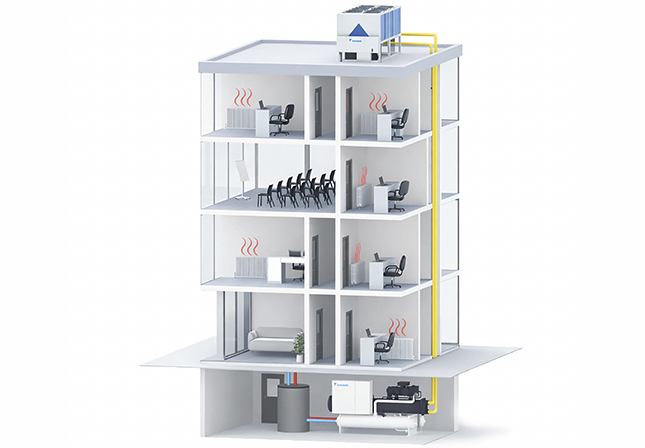
A Daikin cascade system, consisting of an air source and water source heat pump operating together to achieve high leaving water temperatures, and making it suitable for refurbishment projects
Control strategies and system stability
A robust control strategy is the final requirement for a successful installation. The narrative should define all system modes of operation, plant rotation and interlocks.
Systems using propane or ammonia often prioritise low-temperature continuous operation to maximise seasonal COP, whereas CO₂ systems are frequently optimised around DHW demand profiles and thermal storage charging cycles.
For systems with thermal storage and buffer vessels, a stratified store should have multiple temperature sensors to provide trigger points for staging the heat sources.2 For example, the primary heat pump might activate when the store drops to 50% capacity and deactivate at 90%. Where an ASHP provides the primary source of heat, controls must ensure the vessel maintains sufficient heat to supply the building continuously while the ASHP is in defrost cycle.
In bivalent and hybrid systems, control logic must ensure the heat pump is switched on first to meet demand, with the secondary source – a gas boiler, for example – triggered only when the required flow temperature exceeds the heat pump’s capabilities.
In ground source systems, controls must manage environmental limits, ensuring the temperature difference between abstracted and rejected water stays within regulatory limits. For closed-loop systems, controls must monitor and balance the amount of heat rejected to, and extracted from, the ground annually to prevent localised ground cooling.
In all systems, managing variable flows is essential; controls should ensure that the flow in the condenser or evaporator is varying at any given time, not both, to give the system time to stabilise, to prevent unstable compressor modulation.
Advanced strategies now use machine learning to anticipate frost formation based on humidity and weather forecasts, rather than reacting after the evaporator is already blocked.
For air handling unit (AHU) integration, controls should adapt setpoints based on real-time demand rather than running at fixed design temperatures. CIBSE Journal CPD Module 259, ‘Integration of heat pumps into air handling units’, considers AHU integration in more detail.
The commercial case
Any economic assessment of a proposed heat pump project will need to adequately capture all the capital costs associated with the installation, operational costs, including electricity, maintenance, and replacement costs of equipment. These costs are then compared with a counterfactual case: business-as-usual costs or those of an alternative low carbon solution.
Additionally, social benefits and social costs of solutions should be captured, such as those resulting from carbon emissions and changes to air quality.
Design choices can also impact return on investment. For example, specifying multiple smaller modular heat pumps to meet part-loads efficiently – thereby eliminating the need for a large, inefficient thermal store – has been shown to pay back the increased capital costs in three to five years.2 However, specific operational scenarios and system optimisations can yield significantly faster returns.
For those looking to make the commercial case for a heat pump installation, CIBSE AM 17: 2022 Heat pump installations for large non-domestic buildings points readers to guidance provided by HM Treasury. Its The Green Book: Central Government Guidance on Appraisal and Evaluation (HM Treasury, 2020) provides broad guidance on the appraisal of projects. Supplementary tables published with the Green Book provide future carbon and energy cost projections for use in economic models.
Ultimately, successful commercial heat pump strategies rely on the engineer’s ability to balance refrigerant properties, hydraulic architecture and building loads. By moving beyond introductory descriptions and focusing on high-lift thermodynamics, cascaded configurations and robust control narratives, the industry can deliver systems that meet regulatory requirements, such as Part L, and the urgent mandate for building decarbonisation.