
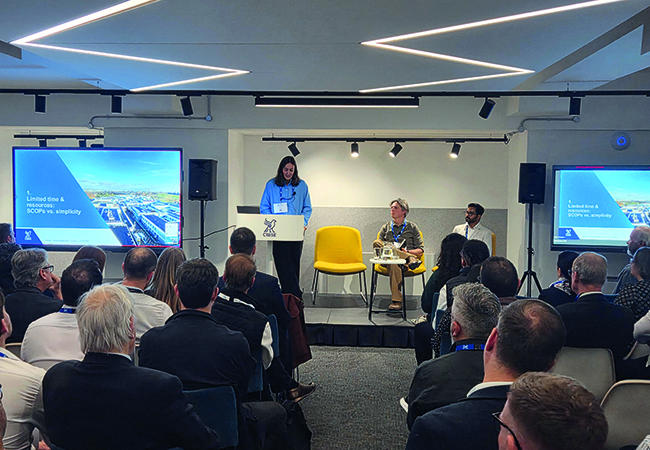
The CIBSE Heat Pump Summit was a fitting choice for the first event to be held at the newly opened Manly Trust Skills Hub at CIBSE’s head office.
As part of the skills hub project, CIBSE replaced a gas boiler with an efficient variable refrigerant flow heat pump, and took a big step towards decarbonising its heating (see page 34).
The Heat Pump Summit offered more than 100 delegates an insight into designing and operating heat pumps with support from headline sponsor Panasonic, and sponsor Mitsubishi Electric. Sessions covered guidance, real-life applications, regulatory landscape, and skills and training.
In the first session, Josh Bird, founder of Rethink Buildings, summarised CIBSE’s guidance, including AM17 and the forthcoming AM17.1 guide for retrofitting of heat pumps in non-domestic buildings. (Bird is co-author of both). He also referred to TM51 Ground source heat pumps, due to be published in the autumn.
Bird described the availability of high-temperature heat pumps as a ‘dangerous inflexion point’, as it means they could now be used as straight swaps for gas boilers without any need to improve building fabric.
While he still subscribed to the fabric-first approach, he recounted a £1.7m housing project for which it would have cost £500,000 more to internally insulate the walls to reduce heat losses by just 20%.
Public sector reality
Iona Norton, who co-authored AM17, spoke about her experience as the programme director of sustainability and infrastructure at Lewisham and Greenwich NHS Trust. She highlighted three areas in which she saw designers struggle in the public sector: balancing simplicity with system efficiency; designing within constrained funding environments; and planning phased decarbonisation for heterogeneous estates.
Norton urged designers not to overcomplicate system design, as the public sector has limited resources to operate complex machines.
‘The onus is on designers to reduce the burden by including simplicity in their designs,’ she added.
While a building engineer might dream of the perfect hospital decarbonisation with fabric upgrades and new systems, Norton said there may be only enough money to replace a boiler with a heat pump.
This might be the most practical solution where there is only funding to decarbonise primary systems, she said, adding that the challenge for designers is for interim projects not to ‘lock us
into inefficiency’.
CIBSE technical manager Dr Jaydeep Bhadra described the upcoming CIBSE domestic heat pump design and installation guide, aimed at installers and practitioners, including those currently working on gas boilers.
‘It’s written in a way to encourage installers and designers to consider the system, not just the heat pump,’ he said.
Heat Pump Association co-chair Laura Bishop said there were issues with poorly installed and controlled heat pumps, especially in the public sector, and emphasised the need for proper hydronic design and training for installers and designers.
In an afternoon session on training, Sally Godber, director at WARM and training body Coaction, highlighted areas in which engineers need to increase their understanding of heat pump design and installation in order to deliver high-performing systems.
She added that it was important to size heat pump systems properly based on heating load across different operating conditions. There must be adequate airflow around heat pump units, and control strategies had to be optimised to ensure efficient operation. Godber also remarked on the importance of properly insulating distribution pipework to minimise thermal losses.
“Our knowledge early on in the process can make really big differences”
Decarbonisation Conference
CIBSE also held a Decarbonisation Conference in April, at the British Library. Dr Anastasia Mylona, technical director at CIBSE, opened the event by setting the stage for the industry’s role in the UK’s transition to net zero.
The first session focused on the pathways to low carbon heat. Channa Karunaratne, district energy market sector lead at Aecom, highlighted how flexible heat networks (backed by £1.5bn in government funding) can adaptively capture diverse sources of waste heat.
A prime example is the South Westminster Area Network (SWAN) plan, an ambitious project sourcing 60% of its energy directly from the River Thames to provide low carbon heating required by hard-to-treat historic landmarks, such as the Houses of Parliament and Somerset House.
Anna Mavrogianni, professor of sustainable, healthy and equitable built environment at UCL, addressed the rising cooling demand in a warming climate and the need for resilient, low-energy cooling solutions. She said models suggest up to 90% of UK housing could be at risk of severe overheating by the mid-2030s.
To protect highly vulnerable populations and prevent low-income ‘cooling poverty’, Mavrogianni advocates for prioritising passive interventions. Night ventilation is an example, she says, which can reduce temperatures by 1.65°C and be supplemented by targeted, energy-efficient active cooling in high-risk zones.
Lawrence Leask, managing director at Kaizen Energy Consultancy, warned that poor design, installation and maintenance practices are undermining the efficiency of domestic heat pumps and commercial variable refrigerant volume systems.
He identified three issues, beginning with the use of non-UV-rated external insulation on pipework. Without protection, insulation becomes brittle and quickly absorbs water, severely reducing thermal efficiency. Presenting a case study, Leask said there was a 7.5% loss in thermal efficiency for every 1% of moisture, and total failure at 13.3% moisture.
Leask also warned that restricted ventilation around poorly sited chillers can cause ‘short cycling’, where expelled warm air is drawn back into the intake. This can strain the system and slash equipment lifespan.
Finally, he warned that, when cleaning condensors, high-pressure jet washing can permanently damage delicate fins. He said maintenance should carefully remove debris using a soft vacuum in a counterflow direction.
Final thoughts
In the final presentation, Sasha Krstanovic, of mstep, discussed leadership across the supply chain, emphasising that decarbonisation is a collaborative effort between manufacturers, designers and clients.
She highlighted that, while regulations define net zero goals, building services engineers are responsible for the ‘heavy lifting’ in implementing low carbon designs, impacting up to 30% of global emissions.
To prevent sustainable solutions from being diluted by budget or familiarity, engineers must fiercely defend their designs, Krstanovic said. They must intervene early in architecture, form strategic project alliances and use performance data to prove green technology viability.
‘We go first where low carbon is concerned… not architects,’ she said. ‘Our knowledge early on in the process can make really big differences.’
With thanks to headline sponsor Mitsubishi Electric, and additional sponsors Qvantum, Rinnai and Refra.