
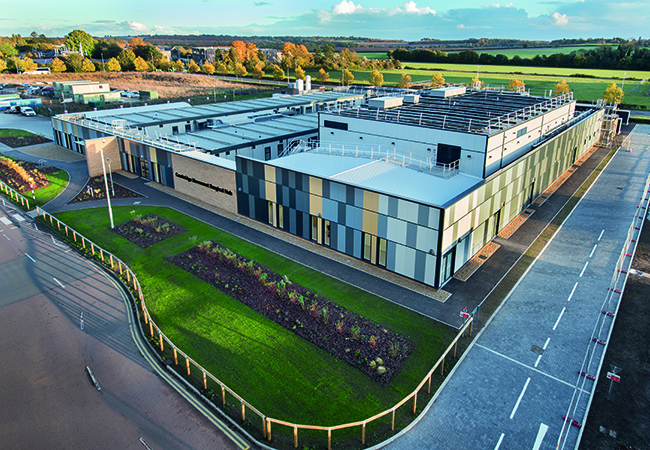
The Cambridge Movement Surgical Hub was built to reduce the backlog of NHS operations
A trio of HVAC projects at Addenbrooke’s Hospital in Cambridge demonstrates what the future of building services might look like. What began six years ago as a relatively conventional chiller retrofit has evolved into a sophisticated, integrated system combining heating, cooling, onsite generation and power management that challenges long-standing assumptions about how HVAC systems are designed and operated.
Significantly, these systems are not the result of a single innovation, but the convergence and integration of several simultaneous developments: heat pump-based heating and cooling, embedded, advanced digital controls, and direct current (DC) microgrid architecture. Together, they point to a future in which HVAC systems are more efficient, more autonomous, and aligned more effectively with renewable energy and an electrified energy system.
The three HVAC systems described here have been developed by industrial refrigeration specialist Arriba Technologies as a succession of schemes on the hospital campus, each building on lessons learned from its forerunner.
‘While the projects don’t physically touch each other, they all feed into the hospital’s bigger vision, which is to become net zero carbon by 2045,’ explains Steve Connolly, CEO at Arriba Technologies.
The firm’s first project was the retrofit of a chiller plant where variable-speed compressors replaced fixed-speed equipment, improving efficiency and enabling closer matching of output to demand. The system was connected, by way of a DC electrical setup, to onsite solar photovoltaic (PV) generation and supported by battery storage. ‘We said to the client, “you know that now it is actually possible to connect these variable speed machines straight to solar, and we’ve built a test rig to prove it”,’ recalls Connolly.
‘We connected them, but we were late in delivering the system because it was way more complicated than we had initially thought. That said, it worked spectacularly well and is still working nicely, delivering cooling six years on.’
Having demonstrated it was technically feasible to integrate variable-speed HVAC equipment directly with renewable electricity generation, the concept was then extended on a second scheme. This featured a heat pump chiller to deliver heating and cooling from the same machine, again integrated with solar and battery systems.
Its third and most ambitious installation scaled the concept significantly on a new facility incorporating 10 heat pump chillers – together delivering around 750kW – to serve a new hospital wing. While this scheme integrated solar PV, budget constraints meant it was delivered without batteries, although provision remains for their addition in future.
Connolly describes the complexity of controlling and optimising multiple machines, each capable of delivering heating and cooling simultaneously, as ‘an absolutely gigantic challenge’ because of the thousands of heating and cooling permutations. It was a hurdle Arriba Technologies succeeded in clearing and the flagship project, which has been in operation for three years, was recognised with the Innovation accolade at the 2024 Heat Pump Association Awards.
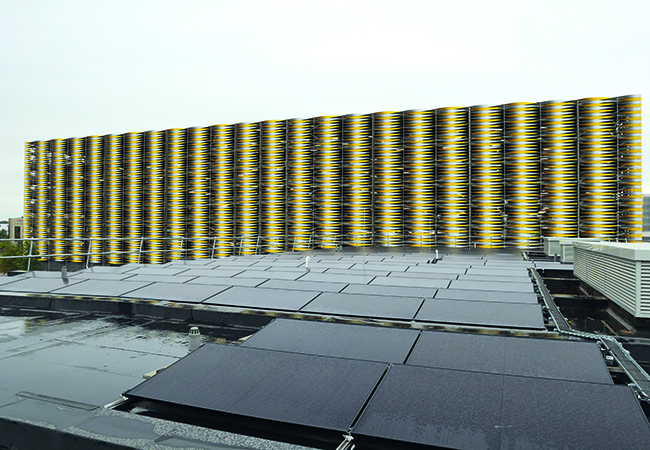
A solar array on the roof of the Cambridge Movement Surgical Hub
Technologies converging
At the heart of these schemes is the convergence of three distinct, but increasingly interdependent, technologies.
Heating and cooling as one system: The transition from separate boilers and chillers to heat pump-based systems is well established. However, the use of heat pump chillers capable of delivering heating and cooling simultaneously introduces new operational possibilities – and complexities.
In such systems, energy can be moved around the building rather than simply added or rejected. Waste heat from cooling processes can be repurposed for heating, improving overall efficiency. When multiple machines are involved, however, each capable of operating in different modes, the number of possible operating states increases dramatically.
Advanced controls and embedded intelligence: Managing this complexity requires a step change in control strategy. Traditional building management systems (BMS) can struggle to respond quickly or optimally to dynamic conditions. The heat pump chillers at Addenbrooke’s have significant computing power embedded within the units. This allows for rapid, local decision-making to adjust outputs in real time as conditions change, whether because of shifts in heating and cooling demand or fluctuations in solar generation.
Embedded DC systems and power integration: Perhaps the most novel aspect of the Addenbrooke’s scheme is the use of embedded DC microgrid architecture within the HVAC plant to reflect that technologies such as solar PV and variable-speed drives operate internally on direct current.
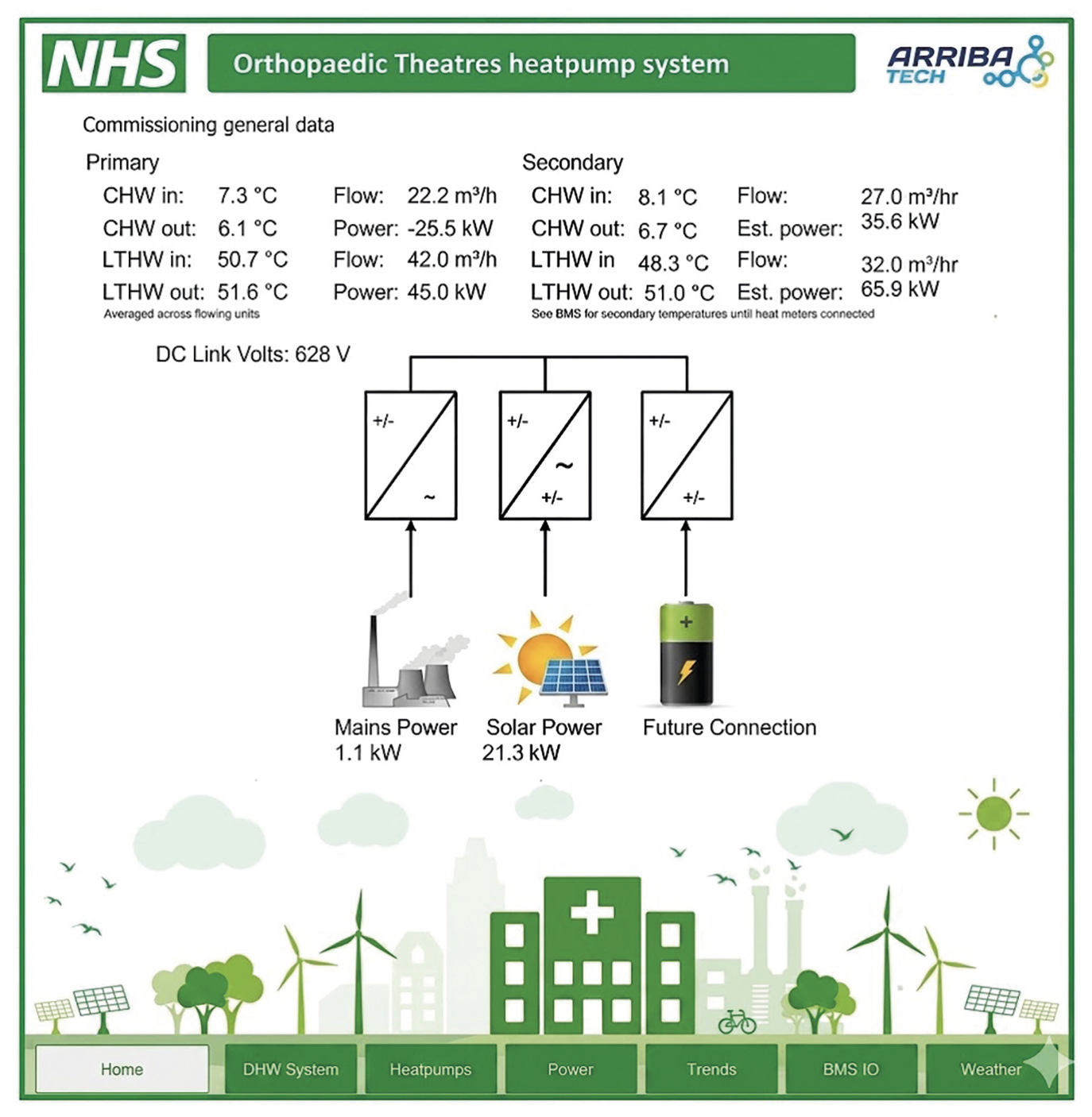
Real-time data showing power generated from solar array for heat pump system. Note connection for potential future battery
In conventional HVAC systems, AC power from the Grid is converted to DC by a rectifier within each piece of equipment, incurring losses and introducing inefficiencies. By contrast, the approach in this project is to connect DC solar generation, through DC-to-DC power convertors, directly to the HVAC equipment, reducing conversion losses and improving overall system performance.
‘If you have a modern building, it will have a big solar array and almost certainly heat pump chillers, where the only way of controlling them is with variable speed motors, which run better off DC directly,’ says Connolly.
The control system continuously, and almost instantaneously, balances power to the heat pump chillers from solar generation and the Grid. On a sunny day, a significant proportion of the plant’s energy demand can be met directly from PV. As conditions change – for example, as a cloud passes over the array, or the heating or cooling loads vary – the system adjusts in real time, drawing more or less power from the Grid as required.
‘The controls enable the machinery to adjust in terms of how much solar power it will take versus how much power it will take from the conventional power grid,’ explains Connolly.
A distinctive feature of the approach at Addenbrooke’s is that the DC power management architecture is embedded directly within the HVAC plant, rather than implemented as a separate, building-wide microgrid.
Given that HVAC represents the majority of the electrical load, Connolly says his team chose to integrate DC distribution and control functions within the plant itself rather than create a standalone building microgrid.
This embedded microgrid approach simplifies installation, enables clients to procure a single integrated system and provides a single point of responsibility for system performance. ’By targeting high-power HVAC motors, it is possible to create big wins for the building owner without the complexity of integrating every electrical system within the building,’ adds Connolly.
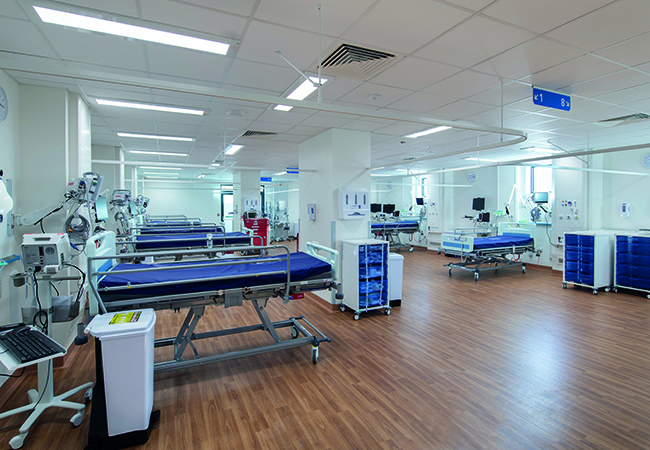
The orthopaedic theatre at Cambridge Movement Surgical Hub
Performance, cost and Grid interaction
From a capital cost perspective, the integrated approach ‘is broadly comparable with conventional systems when batteries are excluded’, says Connolly. Instead, the main benefits of the approach are realised in operational performance.
A saving of 7-8% in direct electrical consumption is possible as a result of eliminating the need for a rectifier by using DC directly in a variable speed drive unit, adds Connolly. However, the big savings from doing away with rectifiers and using DC architecture come from improved power electronics and reduced disturbances in the building’s 3-phase AC electrical system, he says.
This is because the 6-pulse rectifiers commonly found in HVAC equipment draw electricity in sharp pulses, instead of smoothly, creating harmonic currents that flow back into the building’s AC system. This causes extra heating and losses in transformers, for example, which then have to be derated to avoid overheating.
This reduction in electrical disturbances has implications beyond the building itself. In areas where Grid capacity is constrained, improving the efficiency with which power is used will help defer or avoid costly upgrades, which, for large sites such as hospitals, can represent a substantial long-term benefit.
Despite these advantages, adoption of integrated systems has been gradual. The main barrier has been technical complexity from integrated systems that span multiple disciplines. However, this situation is beginning to change, says Connolly: ‘Demonstration projects such as Addenbrooke’s provide evidence of performance and reliability, while growing interest from major manufacturers and technology companies is helping to validate the approach.’
There are also signs that new tools, particularly those based on artificial intelligence, ‘may accelerate adoption by enabling more sophisticated system design and optimisation’, he adds.
Connolly believes the next frontier lies in controls and computation, with the integration of powerful edge computing within plant and equipment – which, he says, will open the door to systems that can effectively manage themselves.
‘We think embedding great amounts of computing power into the machinery is the way forward, because it’s cheaper for the customer and it reacts more quickly.’
As a consequence, future buildings could adapt continuously to changing conditions, rather than have to rely on manual adjustments or predefined schedules – a process Connolly calls ‘self tuning’.
The work at Addenbrooke’s Hospital does not represent a finished solution, but rather a glimpse of what is possible when established technologies are combined in new ways.
For engineers, this offers both a challenge and an opportunity: the tools and technologies are already available, but realising their full potential requires a willingness to move beyond traditional silos and embrace a more integrated approach.
In that sense, the story of Addenbrooke’s is not just about one hospital, but about the future direction of the whole industry
From a capital cost perspective, the integrated approach ‘is broadly comparable with conventional systems when batteries are excluded’, says Connolly. Instead, the main benefits of the approach are realised in operational performance.
A saving of 7-8% in direct electrical consumption is possible as a result of eliminating the need for a rectifier by using DC directly in a variable speed drive unit, adds Connolly. However, the big savings from doing away with rectifiers and using DC architecture come from improved power electronics and reduced disturbances in the building’s 3-phase AC electrical system, he says.
This is because the 6-pulse rectifiers commonly found in HVAC equipment draw electricity in sharp pulses, instead of smoothly, creating harmonic currents that flow back into the building’s AC system. This causes extra heating and losses in transformers, for example, which then have to be derated to avoid overheating.
This reduction in electrical disturbances has implications beyond the building itself. In areas where Grid capacity is constrained, improving the efficiency with which power is used will help defer or avoid costly upgrades, which, for large sites such as hospitals, can represent a substantial long-term benefit.
Despite these advantages, adoption of integrated systems has been gradual. The main barrier has been technical complexity from integrated systems that span multiple disciplines. However, this situation is beginning to change, says Connolly: ‘Demonstration projects such as Addenbrooke’s provide evidence of performance and reliability, while growing interest from major manufacturers and technology companies is helping to validate the approach.’
There are also signs that new tools, particularly those based on artificial intelligence, ‘may accelerate adoption by enabling more sophisticated system design and optimisation’, he adds.
Connolly believes the next frontier lies in controls and computation, with the integration of powerful edge computing within plant and equipment – which, he says, will open the door to systems that can effectively manage themselves.
‘We think embedding great amounts of computing power into the machinery is the way forward, because it’s cheaper for the customer and it reacts more quickly.’
As a consequence, future buildings could adapt continuously to changing conditions, rather than have to rely on manual adjustments or predefined schedules – a process Connolly calls ‘self tuning’.
The work at Addenbrooke’s Hospital does not represent a finished solution, but rather a glimpse of what is possible when established technologies are combined in new ways.
For engineers, this offers both a challenge and an opportunity: the tools and technologies are already available, but realising their full potential requires a willingness to move beyond traditional silos and embrace a more integrated approach.
In that sense, the story of Addenbrooke’s is not just about one hospital, but about the future direction of the whole industry.
Current/OS (currentos.org) is a non-profit, independent global foundation dedicated to defining and advancing standards for DC microgrids. It aims to promote energy efficiency and resilience in commercial, residential and data centre buildings by enabling seamless integration of DC sources, such as solar panels, and loads such as LED lights and electric vehicle chargers.‘Current/OS: