
Air and water source heat pumps have been installed in the retrofit of the 70,000ft2 Omnibus Building in Reigate, Surrey
Heat pumps are no longer an emerging technology. Their thermodynamic performance is well established, their role in decarbonisation is widely accepted and, in many applications, they can deliver high efficiency and low operational carbon.
Yet deployment is well short of policy ambition. The question is no longer whether heat pumps work, but why they remain difficult to implement at scale.
A recent symposium* held in London, drawing on work from the International Energy Agency Heat Pump Technology Collaboration Programme and UK research initiatives, provides a useful lens through which to examine this gap between performance and practice.
From a diverse set of contributions, there is a consistent message. Barriers to adoption are no longer primarily thermodynamic; they lie in acoustic constraints, infrastructure limitations, system integration, user acceptance, and the realities of different building types and ownership structures.2, 6
To decarbonise buildings, heat pump deployment must move from incremental growth to industrial scale. Installations worldwide are expected to rise from around 180 million in 2020 to 600 million by 2030. The UK ambition is for 19 million domestic installations by 2050 and a target of 600,000 per year by 2028.1
Current delivery falls well short, however. While recent targets implied around 200,000 UK installations in 2024, actual market activity has been significantly lower.1
This is not just a funding issue; it reflects a misalignment between technology, buildings, infrastructure, economics and client capability, particularly in smaller non-domestic projects where procurement routes are often informal.5
One constraint is noise. Evidence from UK installations indicates that a significant proportion of proposed air source heat pump systems fail to meet planning guidance, often by small margins. As illustrated in Figure 1, differences of around 1dB can determine whether a scheme proceeds, creating a sensitive – and, effectively, binary – compliance regime.2
Prediction methods show variability of several decibels, while human perception is influenced by tonality, intermittency and context. As heat pump adoption increases, the cumulative effect of multiple units becomes more important.2
The practicalities of delivery are equally significant. Non-domestic buildings account for around 17% of UK energy use.3 The sector is highly heterogeneous, ranging from large, well-resourced estates to smaller buildings where retrofit decisions are less formalised. In this context, implementation often proves more challenging than the technology itself.
Early engagement with electricity networks is critical, as heat pump installations can increase electrical demand significantly. If not addressed early, approval processes can become programme-critical constraints.
A detailed understanding of existing systems is essential. Issues such as plant location, water quality, hydraulic configuration and planning limits all influence feasibility. Where projects are tied to fixed delivery windows, delays in early-stage decision-making can determine whether schemes proceed.3
Heat pumps cannot always be treated as direct replacements for existing boilers. They form part of a system that must be integrated carefully. Pre-installation checks, including hydraulic separation where required, are often necessary to avoid inheriting legacy problems.
Commissioning is equally critical. Achieving design performance requires not only water balancing, but also heat balancing under realistic load conditions, ideally during winter operation. Early monitoring data indicates that performance can vary from initial expectations, with commissioning and subsequent optimisation playing a key role in achieving design intent.3, 4
Existing building characteristics contribute to the challenge. Many were designed for higher-temperature systems, whereas heat pumps typically operate efficiently at lower flow temperatures. This mismatch can require emitter upgrades or use of higher-temperature systems. Cold and damp conditions can further affect performance through frosting and defrost cycles.1
Research is exploring ways to reduce inherent inefficiencies. One example is the quasi two-stage cycle that recovers energy normally lost during expansion and reuses it within the system. By reducing the effective compression lift, this can improve efficiency without additional mechanical complexity. It illustrates a trend towards reducing internal losses rather than always relying on hardware.1
The relative cost of electricity and gas, often referred to as the spark gap, continues to influence viability. Where electricity prices are significantly higher, heat pumps must achieve high efficiencies to be cost-competitive. In some non-domestic applications, this has resulted in substantial carbon reductions being accompanied by increased operating costs, reinforcing the importance of performance, tariff structures and renewable integration.3
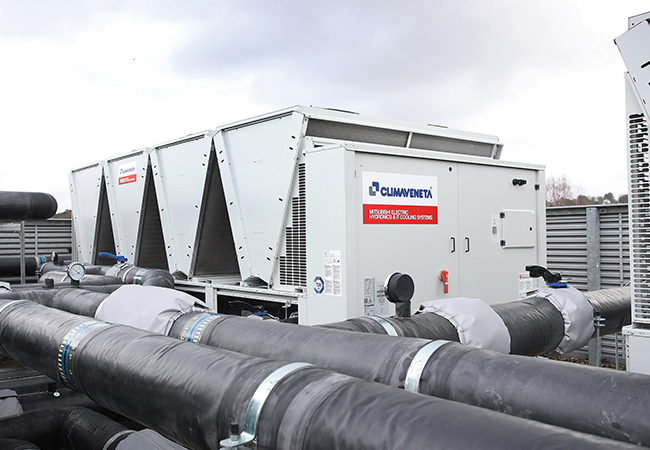
Mitsubishi Electric supplied a 4-pipe heat pump system providing heating and cooling at the Omnibus Building
Integrated solutions
Combining heat pumps with onsite renewable generation, such as solar photovoltaics, can improve economics. Alternative delivery models, including power purchase agreements and energy-as-a-service, can also reduce upfront capital barriers. These approaches reflect a shift from viewing heat pumps as individual plant towards considering them as components within a broader energy strategy.3
User experience is central. Field trials, particularly of air-to-air systems, show that acceptance depends on comfort, control and perceived performance as much as efficiency. Systems departing from conventional heating models may require behavioural adaptation.6
An online tool from the IEA Heat Pumping Technologies programme provides simple decision support for non-domestic building owners considering heat pump retrofit. Using a structured Q&A format, it helps users identify viable system options, rule out infeasible approaches and highlight missing information before engaging with suppliers. Outputs include shortlists of system types, supported by case studies and indicative comparisons of cost and carbon savings. The tool is currently in testing and reflects the need to support early-stage decision-making in a sector where procurement routes are often informal and technical expertise may be limited.5Project 60: early-stage guidance for heat pump retrofit
Emerging technologies may help address some constraints. Thermoacoustic and solid-state heat pumps offer alternative architectures that can reduce noise and enable deployment in more constrained settings. Flats and dense urban housing present particular challenges related to space, planning, ownership and disruption, which may require different system approaches. These technologies may expand the range of buildings that can be practically decarbonised.6
Subsurface systems, including ground source heat pumps and aquifer thermal energy storage, offer the potential for stable operation and seasonal balancing. However, recent field-scale studies show that subsurface behaviour can differ significantly from design assumptions, with factors such as fracture flow influencing heat distribution. This highlights the importance of site-specific data and ongoing validation. 4
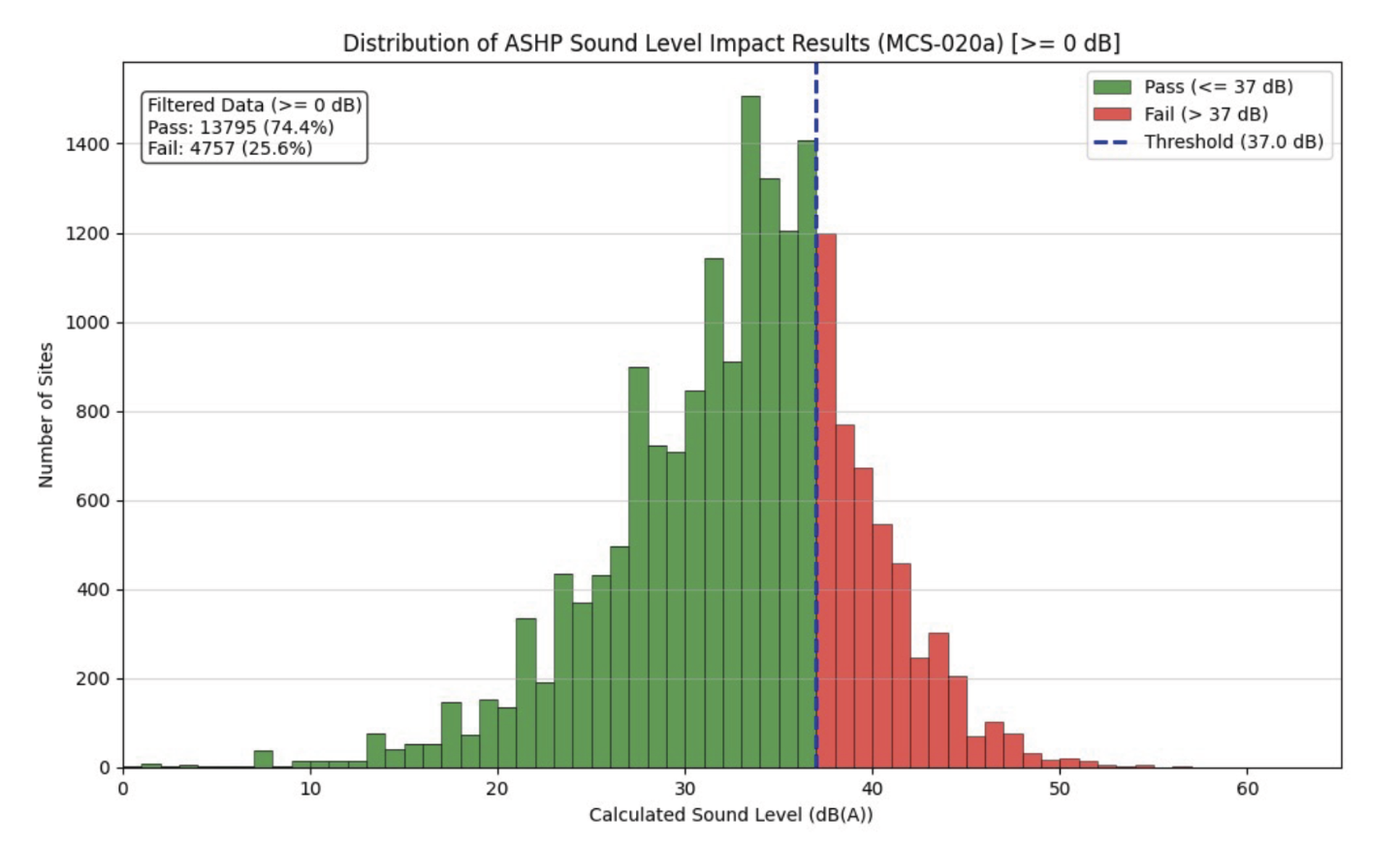
Figure 1: Distribution of predicted ASHP sound levels against the MCS 020a planning guidance limit for domestic installations, showing that a significant proportion of proposed systems fail compliance, often by a very small margin.2
Across the research landscape, a broader shift is evident. Innovation is increasingly focused on system-level performance and real-world operation rather than individual components. Monitoring and feedback are key, not only to verify performance, but also to support iterative optimisation and build confidence in future deployment.3, 4
These insights suggest that the transition to low carbon heat requires a more comprehensive framework for decision-making. Efficiency and carbon must be considered alongside installability, acoustic impact, infrastructure constraints, user acceptance and economic viability. Different building types and contexts will require different solutions.
One response is the use of tools to support early-stage decision-making, particularly for clients unfamiliar with heat pumps (see panel, ‘Project 60’).
Building services engineering is shifting from optimising components to managing real-world systems in which technical performance, human factors and economic conditions must align. It is within this space, between performance and practice, that the success of heat pump deployment will be determined.
REFERENCES:
1 The Flexible Heat Pump Technology: A quasi two-stage cycle for enhanced efficiency and broad applications, University of Liverpool
2 Noise as a barrier to ASHP installations, Jack Harvie-Clark
3 Heat pump deployment in practice, Oakes/PHS (DESNZ–IEA Seminar)
4 Ground source heat pump retrofit: BGS Keyworth Living Lab; and UK Geoenergy Observatory and ATES Research
5 Project 60: Online interactive guidance tool, IEA Heat Pumping Technologies
6 Beyond compressors: heat pumps in transition, Dr Jonathan Siviter; and Air-to-air heat pump trials in UK homes, Energy Systems Catapult
*The DESNZ/IEA Heat Pump Research Symposium explored current and emerging research within the IEA Heat Pumping Technologies Technology Collaboration Programme, and included experts from across industry, academia, research centres and government considering cutting-edge UK projects.