
Seven industry discuss the challenges of the building fire safety regime
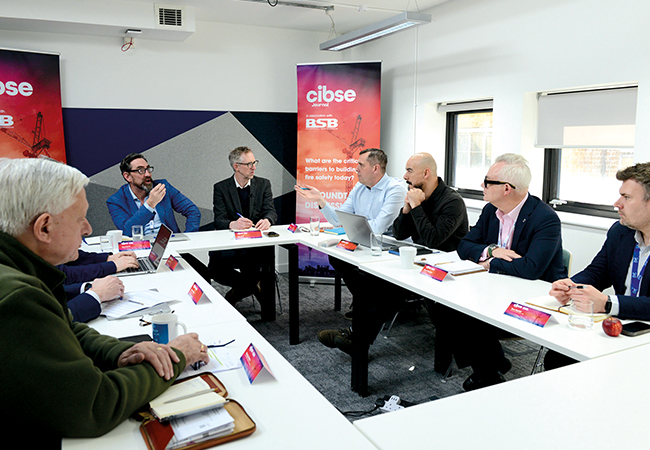
What are the critical barriers to building fire safety today? That was the question posed to seven industry experts at a recent CIBSE Journal roundtable at the Institution’s headquarters in central London.
The 2022 Building Safety Act (BSA) introduced a new regime aimed at transforming the building control process to ensure a consistent standard across all building types.
For legal accountability, the BSA created five core ‘dutyholder’ roles – client, principal designer, principal contractor, designers and contractors – that apply to every project, regardless of the building’s height or use. Each of these roles has a separate legal obligation to ensure the building complies with Building Regulations.
Click here to watch the video, which showcases highlights from the day:
A legal obligation for competence, plus requirements to demonstrate this, applies across the board, and a Building Safety Regulator (BSR) has been created to oversee the regime.
Three years on from the BSA’s enactment, the roundtable explored some of the challenges emerging from its implementation.
George Adams – chair of CIBSE Building Safety working group Peter Anderson – chair, Troup Bywaters + Anders; CIBSE board Russell Cole – director, Arup David Fitzpatrick – MD, BSB Engineering; chair of CIBSE fire safety working group Alex Hill – MD, Whitecode Consulting Giulio Tonelli – Building Regulations principal designer, Buro Happold Ceri Roberts – principal fire engineer, Vinci ConstructionThe panel
Ceri Roberts, principal fire engineer at Vinci Building, began the debate: ‘The Building Safety Act was needed because it had become a race to the bottom in terms of quality and standards, especially producs but it’s a challenge,’ he said.
Peter Anderson, chair of Troup Bywaters + Anders, who sits on the CIBSE Building Safety working group, stressed the need for the industry to continue to strive for quality, and added: ‘The fundamental challenge is how we make everything that’s coming through, in terms of legislation and guidance, as straightforward as possible and how we, as leaders, communicate this to everyone who works with us.’

George Adams
The industry had to change and this is part of the change process. It’s about time it grew up, professionalised and did its job properly
The industry’s diminishing capability to cope with BSA requirements was the concern of George Adams, chair of the CIBSE Building Safety working group and member of the Beengineering council for Besa. ‘There is a significant shortage of resources – and it seems to be getting worse,’ he said. ‘Our ability to meet the increased legislation is a real issue.
‘My key worry is that the government has never issued guidance for the industry to work to. We’ve all got to make the best we can of the legislation that’s issued. ’
Ceri Roberts was somewhat critical of the guidance surrounding the Act, which he suggested was not offering clear solutions to specific construction issues, not covered in guidance, especially when working on existing buildings. ‘Due to existing non-compliance issues, Tier 1s and its supply chain, are expected to provide the solutions, which does improve the safety of a building, but ergo, may be subject to rejection due to perception of strict compliance.’
Although current guidance surrounding BSA appears very binary at present, there is scope to prove compliance with the functional requirements, says Roberts. However, he says the supply chain is unwilling to make a professional judgement or take responsibility of any required engineered design for fear of future liability.

Peter Anderson
We can now demonstrate that everyone across the chain is competent
Insurance
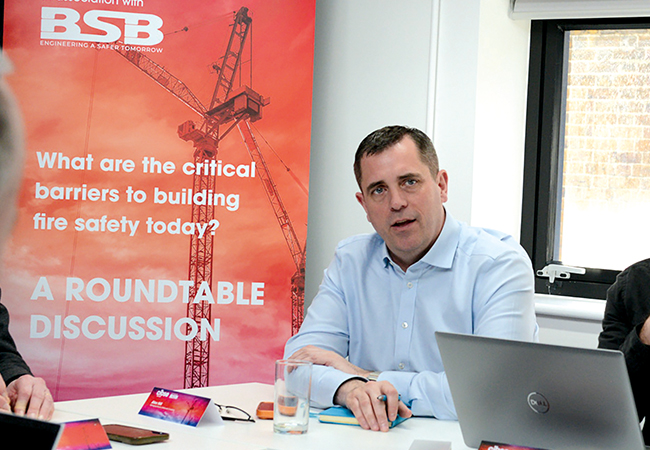
Alex Hill, MD of M&E practice at Whitecode Consulting, identified a significant issue around project insurance relating to potential liability under the new legislation.
‘The problem is that everyone’s so nervous of getting it wrong because of the potential “criminal” liability within the legislation,’ he said. ‘I worry that it might make some projects uninsurable. We can deliver whatever people want, but the question is whether people are prepared to insure it.’
Hill outlined how some firms will not give fire safety advice if it is an interpretation of the standard that may not be approved by building control and, therefore, isn’t economically insurable. ‘Also, that concern about liability is another reason why building regulators are being completely inflexible.’

Russell Cole
There are legacy projects still grinding through the process
The participants agreed that this was a significant issue thrown up by the new regime, and David Fitzpatrick – BSB Engineering MD and chair of the CIBSE Fire Safety group – pointed out: ‘As a manufacturer, we’ve had to look at design insurance, because if we make a recommendation about using a product, are we effectively liable as a designer under the BSA, as it is unclear between technical support and design sometimes?’
Inconsistent interpretation
Hill suggested that the regulator is deterring some clients from building beyond a certain height because this would trigger the time- and resource-consuming gateway process introduced by the BSA.
The aim of the gateways – of which there are three – is to enhance safety standards and oversight for higher-risk buildings (HRBs) in the design, construction and occupation phases.
Gateway 1 focuses on obtaining planning permission by demonstrating that the proposed design meets necessary safety requirements; Gateway 2 involves rigorous inspections during construction to verify adherence to the approved plans; and Gateway 3 ensures that the building is fit for occupation.
The BSR needs assurance that safety issues have been considered at key project stages, and navigating the gateways requires collaboration between building owners, designers, contractors and regulatory bodies. Failure to meet requirements can result in penalties and delays.

David Fitzpatrick
If we recommend using a product, we are effectively liable as a designer under the BSA
Fitzpatrick said the gateway regime had initially caused many projects to be knocked back because of a lack of detail, but that principal designers had learned and adapted their process to comply. ‘They’re understanding that they can’t just pass that down to the M&E contractor or the fire engineer. They’re legally responsible for their obligations, so it requires different behaviours.’
Hill claimed there is inconsistency in the way the regulations are interpreted by the different technical advisers appointed by the BSR as part of the multidisciplinary team reviewing Gateway 2 submissions for HRBs.
Nonetheless, Anderson acknowledged the importance of the BSR in professionalising the fire engineering role in construction. ‘The accountable person is responsible for having an up-to-date fire strategy, fire assessment, and so on, and handing that strategy from one person to another is key throughout the life of a building . I’ve seen buildings where there are three different fire strategies in existence that contradict each other.’
Alex Hill
There are a lot more conversations happening earlier about costs, about product selection
Proving/improving competence
Anderson said another benefit of the regime is that it drove his firm to reflect on competence and ensure it was capable of meeting HRB thresholds. ‘We had the knowledge and the culture of [correct] behaviour, but we didn’t have a documented form the regime requires. By formalising processes we can now demonstrate that everyone across the chain is competent.’
Giulio Tonelli, principal designer at Buro Happold, agreed. ‘One thing that was really needed was encouragement for the industry to better understand the building control process, alongside clearer definition of roles and responsibilities across the various dutyholders.
‘The competency element is a positive addition and should not deter people. At Buro Happold, we were competent before the new regime was introduced and we remain competent today. However, the changes have presented a valuable opportunity to reinforce our internal management systems, improve the way we work and, most importantly, when it comes to delivering design and build projects, reiterate that compliance is the responsibility of everyone.’

Giulio Tonelli
As a designer, you are aware that no one else should be checking a product you’ve selected – it’s your responsibility to know
Early engagement
Whitecode Consulting’s Hill said a benefit of the BSA is that designers now have a legally defined role with specific liabilities, so value engineering is now more difficult. If a contractor wants to change a product that affects safety or the original ‘design intent’, it may have to go back to the BSR for a major change control approval.
‘Value engineering is now very difficult to do if it’s gone into the BSR process. So there are a lot more conversations happening earlier about costs, about product selection,’ said Hill.
‘Another important element is that products selected are now being checked by building control to ensure they have been tested for the application for which they have been designated.’
This is the product and compliance testing verification process, which requires a Declaration of Performance, with a lab report showing the product passing a test in a specific configuration.
Hill believes this could deter innovation on smaller projects, because testing a product for a new application is expensive. However, he said the BSR regime has increased awareness of the need to get it right first time, as it can be costly and time-consuming to correct selection errors.
Buro Happold’s Tonelli welcomed the wider awareness of the duties that apply to all projects. ‘Everyone is aware of what we should be doing. As a designer, you are aware that no one else should be checking a product you’ve selected – it’s your responsibility to know.’
However, Hill said the gateway system is causing cost pressures that may make certain projects unviable. ‘By telling projects they can’t proceed past a certain point, there’s a drag on the market that will be terminal for the delivery of certain projects.’
Arup director Russell Cole said that the BSR’s latest reports indicated that its Innovation Unit was starting to make the process more effective, though 56% of projects were still rejected. ‘There are legacy projects that are still grinding through the process, but they are saying the news ones will be going through quicker,’ he said.

Ceri Roberts
The industry had to change and this is part of the change process. It’s about time it grew up, professionalised and did its job properly
Learning curve
The BSR requires building control professionals to be registered, have independent competency assessment qualifications, and undertake regular training and reassessment every four years.
However, many existing inspectors decided not to take on the additional requirements for the new role, resulting in a shortfall of registered building inspectors and an increase in their workload, contributing to the bottlenecks.
Adams, though, believes this was necessary and will lead to a more professional building industry: ‘There has to be a cut-off point, where somebody lays down the law and says, “You’ve got to pull your socks up”,’ he said.
There was concern that building control officers are not able to offer solutions that don’t align completely with a Building Regulation Approved Document. ‘They won’t take any responsibility to give a view on the wording that’s not in a document,’ said Hill.
This is a problem that the industry has to deal with, said Adams: ‘It’s a painful learning curve, but it’s what we have to get through.
‘The industry had to change and this is part of the change process. It’s about time it grew up, professionalised and did its job properly,’ he said.