
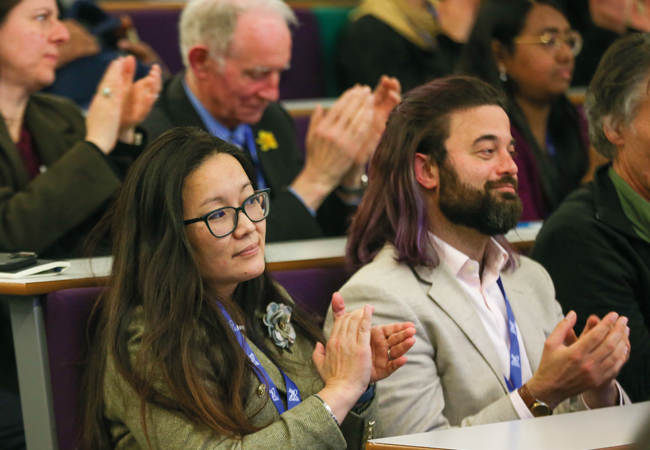
The diversity of building services engineering was evident in the wide-ranging subjects tackled at the 2026 CIBSE Technical Symposium in March.
Titled Fit for 2050 – Redesigning spaces for wellbeing, inclusivity and sustainable performance, the symposium showcased in excess of 80 peer-reviewed research papers to an audience of around 250 at Loughborough University. Topics ranged from the right sizing of heat pumps, to the impact of AI, and use of yoghurt to prevent overheating.
The dominant theme of the two-day event sponsred by IES, Design Builder, and Strebel was that building services engineering must evolve beyond energy reduction to master the whole environment.
Keynote speaker Cath Noakes HonFCIBSE, professor of environmental engineering for buildings at the University of Leeds, highlighted the need for integrated thinking across specialisms to ensure that energy, climate, air quality and safety aren’t treated in isolation.
As an expert on the airborne transmission of disease, Noakes was appointed to the government’s Covid-19 scientific advisory board, where she highlighted the importance of ventilation in containing the virus. Her 2050 ‘utopia’ is a holistic industry in which health is embedded in career development, practitioners understand the impacts of poor environments and buildings have to visibly demonstrate good health.
Noakes said the pandemic helped raise the profile of ventilation, leading to regulatory changes such as a revised Part F, with explicit higher ventilation rates for infection control, widespread use of CO₂ monitors and sustained research on indoor health. She said communicating the complex, multifaceted nature of building performance and health to decision-makers remained a significant challenge, which required more collaboration. ‘If you collaborate, you trust each other; that’s when we can do things really well,’ said Noakes.
There were a range of papers connected to new heat network regulations coming into force this year, including examples of best practice in new and existing networks.
Speaking on behalf of the Department for Energy Security and Net Zero (DESNZ), Phil Jones explained how the regulations aim to ensure the design and operation of heat networks are optimised. ‘We’ve taken a lot of the lessons from the Building Safety Act to make the developer, owner and lead designer responsible for the heat network,’ he says. ‘It puts the onus on all of these people to make it work.’ (See panel, ‘Laying the groundwork for heat networks’).
Right-sizing heat pumps
Several sessions on heat pumps emphasised that, while the technology is efficient, its real-world success depends on moving beyond simplistic, conservative design towards dynamic, data-driven ‘right-sizing’.
Phil Tower, energy manager at the University of Huddersfield, highlighted the uncertainty in current methods of sizing, noting that a typical engineer’s desire to be conservative leads to massive discrepancies.
‘If you ask four engineers to size a heat pump for my house, they will probably give you four different answers. There’s not enough awareness about the impact of all the different assumptions,’ he explained.
Through sensitivity testing, Tower demonstrated that changing basic assumptions could reduce a required heat pump size from 8.9kW to 3.3kW, and he stressed the importance of sizing. ‘We need to rapidly upscale heat pump deployment – all it takes is a couple of poor installations to lose public faith,’ he said.
Hoare Lea’s Oliver Butcher further critiqued the industry’s cognitive bias towards safety margins. In his talk on a new sizing methodology for HVAC in offices, he argued that traditional steady-state modelling ‘systematically oversizes HVAC plant’, which restricts net zero delivery.
‘For too long we’ve been able to get away with equipment that is too big. We shouldn’t say oversizing any more, we should just say this is wrong design,’ Butcher said.
Overcoming delivery friction
For retrofits to succeed in historic buildings, they must be more people-centric, argued W. Victoria Lee, lecturer in architecture and environment at the University of Edinburgh.
She argued that ‘delivery frictions’ such as costs, planning, skilled worker shortages and disruption were bigger barriers to retrofit, than technical challenges. ‘There are cost and quality risk issues associated with a scarcity of competent tradespeople who specialise in heritage-grade retrofit solutions,’ said Lee.
Success is dependent on owner-occupiers taking on the burden of funding, managing and maintaining retrofits, she added. Owners need access to clearer information and realistic decarbonisation pathways. ‘Having the right information doesn’t always solve the problem, but that is the very first step,’ Lee said.
In the same session, the University of Manchester’s Geoff Livermore spoke about the potential to build new rural renewable energy towns (RRETs) close to the UK’s source of wind and solar power.
He noted that, in 2024, up to 70% of the electricity from Scotland’s biggest wind farms was wasted because of a lack of local demand and there being no grid connection to England.
Building RRETs close to where energy is produced can limit the need for grid infrastructure and be incentivised with lower-priced electricity, said Livermore. ‘The new powerhouses of the world will be in sunny, windy places, offering climate justice to places such as Africa,’ he said.
Intelligent by design
Artificial intelligence (AI) had a significant presence at the symposium, in papers on how machine learning and AI are transforming building services engineering.
The final panel discussion of the first day asked whether building services engineers were being replaced, repositioned or reinvented by AI. The panellists largely concluded that AI is a powerful tool that augments, rather than replaces, human judgement, creativity and ethical responsibility.
Speakers described AI’s rapid emergence across design, controls and operations, and noted its potential to accelerate modelling, optimisation and fault detection – but it still relied on engineers to handle novel problems, trade-offs and context-specific decisions.
However, one audience member said his company no longer had junior building services engineers because their tasks were being carried out by senior staff using design software and AI.
Panellist Jon Belfield, managing director at InTandem Systems, said AI could lead to more interest in practical roles, and he had seen an uptick in students attending events promoting T-Level and apprenticeship courses. ‘I expect to see a shift in labour mobility because of shortages in practical skills,’ he added.
Green infrastructure
Integrating green infrastructure (GI) into building design is a fundamental nature-positive shift that requires engineers to ‘think about other species, as well as the people we are designing for’, said Isabel Why, building physicist at Model Environments, in her paper ‘Plant or plants? A cross-disciplinary investigation of GI integration in low carbon healthy design’.
Research presented by UCL’s Aohua Yang highlighted the functional power of moss, which possesses a microstructure that has 40 times the leaf area of vascular plants (grass, plants, trees). This allows moss to be ‘up to three times more effective than activated carbon’ at removing pollutants, offering potential as a ‘standalone air purifier’ or an ‘integrated prefilter of ventilation exhaust’, Yang explained.
UK energy and overheating compliance typically excludes vegetation, said Why, and this exclusion can lead to significant inaccuracies in modelling. Studies have found a ‘40% discrepancy in heating and cooling calculations’ when surrounding plants were omitted, Why added.
By shifting policy and ‘accelerating the advent of nature-positive buildings’, she said the industry can support biodiversity compliance while providing ‘benefits to mood and positivity’ for future generations.
Best of the best
The symposium concluded with prizes for the best presentations, as voted for by delegates. Kevin Lomas won the prize for most Effective Delivery of Material for his presentation based on the paper ‘Mitigating future summertime overheating in houses: ventilation strategies and ceiling fans’, while Jordan Townsend’s paper was a prize for its contribution to the art and science of building services engineering. Its title is Empirical methods for measuring thermal responsiveness in buildings: Impacts of monitoring design on short-term flexibility assessment.
The papers will be featured in future editions of the CIBSE Journal and symposium papers can be viewed at www.cibse.org/symposium
Laying the ground work for heat networks
Government and industry speakers tackled the seismic changes to heat network regulations, including the proposed Heat Network Technical Assurance Scheme (HNTAS).
Phil Jones FCIBSE, working for DESNZ, and FairHeat’s Ethan St Catherine, technical support to DESNZ, highlighted the draft Metering and Monitoring Standard (MMS), referenced in HNTAS, which is due to come into force in 2027.
They said, historically, metering and monitoring in UK heat networks had been ‘poorly considered’, resulting in low performance visibility, lack of regulatory enforcement and poor outcomes for customers. MMS would allow reporting of key performance indicators to monitor compliance with HNTAS, they added, providing consumer protection.
‘It’s important to plan metering and monitoring early in the design process so we know exactly what we expect to be measuring,’ said Jones.
CIBSE TM39 Building energy metering, due to be updated this summer, will offer guidance on metering, monitoring and commissioning for heat networks.
Joel Hamilton, energy, sustainability and decarbonisation specialist at Translating Energy, outlined a strategy for identifying the worst-performing assets in a heat network portfolio when limited data is available. He said operators should prioritise networks with high energy costs and high per dwelling energy costs, and those with failed – or about to fail – equipment.
FairHeat consultant engineer Nina Dungworth and Gateshead Council’s Matthew Jordinson described a project that replaced gas boilers in 16 council homes with heat interface units (HIUs) connected to the Gateshead District Energy Scheme network, which uses heat from water in abandoned coal mines 150m below the city centre.
The incoming flow temperature was set at 65°C, which meant radiators did not have to be upgraded. HIUs were mounted externally to allow easy access for engineers.
Jordinson said the design strategy allowed his team to focus on the speedy decarbonisation of homes at scale and the plan to upgrade 15,000 properties over the next 10 years.