

Introduction
Heat Interface Units (HIUs) are essential components in district heating systems, providing domestic hot water (DHW) and space heating to individual dwellings. They are broadly categorised into direct and indirect systems, each with distinct operational principles, performance characteristics, and application suitability.
The Altecnic SATK22 and SATK32 HIUs illustrate these two approaches, enabling a clear comparison between direct and indirect technologies.
Fundamental difference: Hydraulic design
Direct HIU (Altecnic SATK22)
A direct HIU connects the primary heating network directly to the secondary heating system (radiators or underfloor heating). Heat is transferred without full hydraulic separation.
- The primary water effectively circulates through or directly influences the secondary system.Fewer heat exchangers are used, simplifying the system design.
- Typically, more compact and cost-effective
Indirect HIU (Altecnic SATK32)
An indirect HIU uses plate heat exchangers to hydraulically separate the primary network from both domestic hot water and space heating systems.
- The Altecnic SATK32 uses a twin plate heat exchanger design, separating both DHW and heating circuits from the primary supply
- This ensures no mixing of primary and secondary fluids
- Provides full system isolation and improved control.
Performance and efficiency
Direct HIU
- Efficiency depends heavily on system balancing and user-side conditions
- As noted, conventional HIUs can result in higher return temperatures if radiators are not balanced, reducing system efficiency
- Less control over delta T across the network.
Indirect HIU
- Designed for optimised network efficiency, particularly through advanced controls.
- The Altecnic SATK32 includes Return Temperature Limitation (RTL), ensuring low primary return temperatures regardless of demand conditions.
- Automatically adjusts output to maintain system efficiency and protect the network from low delta T issues.
Control and Intelligence
Direct HIU (Altecnic SATK22)
Offers advanced electronic control including:
- Room controller with programmable heating and DHW
- Weather compensation
- Anti-legionella function
- Return temperature monitoring
However, control is more reactive, relying on system conditions and user-side balancing.
Indirect HIU (Altecnic SATK32)
Provides more advanced and proactive control strategies, including:
- Independent control of DHW and heating return temperatures
- Maximum primary flow rate limitation
- MODbus connectivity for remote diagnostics and optimisation
Actively protects the heat network from inefficiencies and overload conditions.
Network Protection
Direct HIU Altecnic SATK22
- Limited inherent protection for the district heating network.
- Performance can degrade due to:
-Poor radiator balancing
-High return temperatures
-User behaviour
Indirect HIU Altecnic SATK32
- Specifically designed to protect the network, with features such as:
-Return temperature limitation (RTL)
-Controlled primary flow rates
-Modulating output to maintain design conditions
This makes indirect HIUs particularly suitable for modern low-temperature and energy-efficient networks.
Installation and Application
Direct HIU Altecnic SATK22
- Simpler installation
- Lower upfront cost
- Suitable for:
-Smaller or less complex systems
-Retrofit projects
-Networks where efficiency control is less critical
Indirect HIU Altecnic SATK32
- Slightly more complex and higher cost
- Preferred for:
-New-build developments
-Low-temperature networks (e.g., heat pumps)
-Systems requiring strict efficiency and performance control
The Altecnic SATK32, for example, includes models specifically designed for low primary flow temperature systems, such as heat pump networks.
Domestic Hot Water Production
Both systems provide instantaneous DHW via plate heat exchangers, but:
- Direct HIU Altecnic SATK22: typically uses a single exchanger and relies on primary conditions.
- Indirect HIU Altecnic SATK32: uses separate exchangers and enhanced control, allowing:
-Better temperature stability
-Lower return temperatures
-Improved efficiency under varying demand
Summary of Key Differences
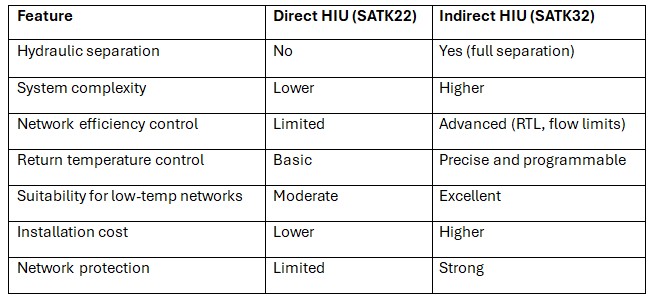
Conclusion
The choice between direct and indirect HIUs depends on project priorities.
- Direct HIUs Altecnic SATK22 offer simplicity and lower cost, making them suitable for straightforward applications.
- Indirect HIUs Altecnic SATK32, however, provide superior efficiency, control, and network protection, aligning with the demands of modern district heating systems—especially those targeting low carbon and high performance.
As heat networks evolve toward lower temperatures and stricter efficiency requirements, indirect HIUs such as the SATK32 are increasingly becoming the preferred solution.
About Altecnic
Altecnic is the UK’s leading supplier of hydronic solutions for both commercial and domestic markets. Part of the Caleffi Group, we deliver high-quality, compliant products to a wide range of sectors, supported by expert technical and customer service teams. We remain committed to innovation, sustainability, and excellence, holding multiple ISO certifications and Investors in People accreditation while serving customers across the UK and Republic of Ireland. For more information, please visit: www.altecnic.co.uk