With 3,466 members, the CIBSE Hong Kong Region is the Institution’s largest region, making up 15% of the global membership – and it’s set to get larger.
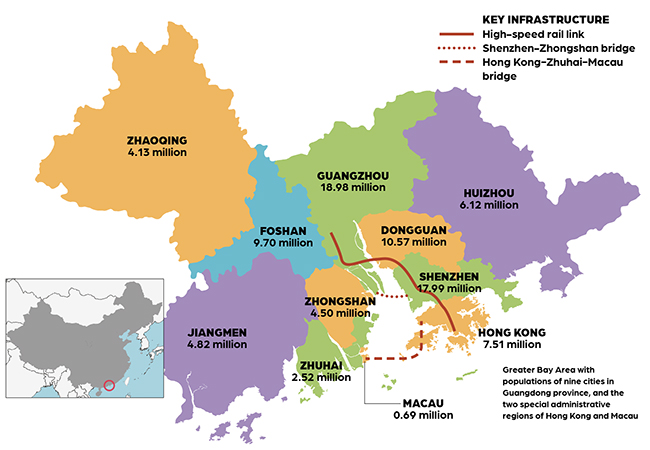
That’s because it sits within the rapidly growing Greater Bay Area (GBA), a metropolis of 87 million people around the Pearl River Delta that covers the special administrative regions of Hong Kong, Macau and nine cities in mainland China’s Guangdong province, including Guangzhou and Shenzhen, which have populations of around 19 and 18 million, respectively.
The region’s economy is similar in size to Germany’s, but with a growth rate of 5% – and an expected population of 100 million by 2030 – it is predicted to outstrip it soon.
While CIBSE’s Hong Kong Region traditionally centres on Hong Kong, increasing connectivity with the GBA means there are now many opportunities across the ‘border’. High-speed rail links from Guangzhou to Hong Kong and the recent completion of the Shenzhong Link (connecting Shenzhen and Zhongshan) have reduced travel times between major cities to less than one hour (see map).
For CIBSE members and other professionals, the improved connectivity turns the GBA into a single ‘local’ market effectively, allowing an engineer to potentially live in Hong Kong or Macau while managing projects in Shenzhen or Zhongshan.
Last November, CIBSE President Elect Dave Cooper and CEO Ruth Carter embarked on a tour of Hong Kong and mainland China to build relationships with institutions and government in the GBA. The Institution is keen for the chartered status of CIBSE engineers in Hong Kong to be recognised across the GBA.
During their visit, Cooper and Carter met senior representatives from the Guangdong Provincial Association for Science and Technology, which represents engineers across the province’s 70 million residents. The discussions focused on mutual recognition of members and reciprocal agreements to share best practice. CIBSE’s representatives also signed a memorandum of understanding with the Macau Institution of Engineers.
CIBSE currently provides the ‘chartered’ foundation that mainland authorities increasingly recognise through an agreement with the Hong Kong Institution of Engineers (HKIE), which it renewed in November 2024.
Under the agreement, CIBSE chartered engineers can apply for corporate membership in the HKIE Building Services Discipline without a full reassessment. Once an engineer holds MHKIE status via the CIBSE route, they become eligible for GBA pilot programmes. This has allowed more than 200 engineers to obtain mainland titles, such as senior engineer, from 2024 to 2025.
China’s 15th Five-Year Plan (2026-30) emphasises regional coordination as vital for achieving high-quality development and modernisation of the GBA by 2035. The area is a powerhouse for IT, manufacturing and healthcare, and Shenzhen, located just across the border from Hong Kong, is known as China’s Silicon Valley.
It hosts some of the world’s most prominent technology companies, including car maker BYD, telecommunications giant Huawei and drone manufacturer DJI. The world’s largest air conditioning company, Gree, is in Guangdong province and the CIBSE delegation visited its factory in Zhuhai.
The 15th Five-Year Plan represents a key stage in China’s journey towards its goal of carbon neutrality by 2060. The GBA is seen as a pioneer of low carbon technologies and will need CIBSE engineering expertise to transition from fossil fuels to clean energy in buildings and infrastructure.
The plan sets a binding target to reduce the amount of CO2 emitted per unit of gross domestic product significantly. Absolute limits on total carbon emissions are also being introduced at regional and industrial levels to ensure the national carbon peak is reached before 2030. In addition, the plan mandates a reduction in coal from 2025-30 and is targeting 25% of primary energy to come from non-fossil fuel sources by 2030.
The creation of 100 national-level zero carbon industrial parks by 2030 also features in the plan. In January, the first batch of pilots was announced, with a heavy concentration in Guangdong’s high-tech hubs (Shenzhen, Guangzhou and Foshan).
The GBA is piloting environmental regulations and low carbon finance mechanisms as part of the State Council’s Beautiful China initiative, which aims to integrate environmental protection with economic development.
There is further evidence in Hong Kong of the inexorable drive for decarbonisation in the GBA. The Buildings Energy Efficiency (Amendment) Ordinance 2025 is designed to strengthen energy performance in the built environment by shortening energy audit cycles and broadening the regulatory scope to bring in more sectors, such as data centres, healthcare facilities and public buildings.
There is also a requirement to submit energy data through standardised disclosure forms. Some of this information will be made publicly available to increase transparency and performance benchmarking.
As the GBA continues to develop into a single, high-tech metropolis, the demand for CIBSE’s rigorous standards in low carbon design and energy auditing will only intensify. The decarbonisation drive represents a generational opportunity for the building services sector to lead from the front.
More the CIBSE Hong Kong Region website for the latest news and events in the region