

In the race to decarbonise the UK’s built environment, the industry frequently fixates on the gleaming promise of new ‘smart’ buildings designed to achieve net zero from the drawing board. Yet, the true battleground for operational energy efficiency lies in the country’s existing, ageing stock.
In November 2024, building services consultant Watkins Payne proved that exceptional operational performance is not exclusive to new developments. By securing a 5.5 Star NABERS UK Whole Building Energy Certified Performance rating for its Surrey office, the consultancy established a UK first: no other office has achieved a 5.5 Star rating under NABERS UK’s Whole Building metrics and it is currently the only one to have achieved any type of Certified Performance 5.5 Rating. Twelve months later, the building maintained its second 5.5 Star rating, with an improved decimal tracking indicator score of 5.65 (a metric introduced by NABERS to allow occupiers to track granular improvements).
With the consultant now aiming for a 6 Star rating, the office project serves as a live case study for NABERS UK, demonstrating the rigour required to maintain and improve operational efficiency in legacy assets. Constructed in the 1970s, the Sunbury-on-Thames office was originally fitted with single-glazed steel-framed windows. Heating and cooling are provided by a local direct expansion heat pump system.
The consultancy pursued a whole building rating for the office, as it is the only tenant. This is often a more demanding metric than the NABERS base building rating sought by developers, as it encompasses the occupier’s lighting and small power loads.
The journey to 5 Stars
The path to high performance began in 2023 with a strategy focused on ‘low-hanging fruit’ – measures that required low capital intervention but promised high impact.
Technical upgrades included replacing compact fluorescent lighting with high-efficiency LEDs equipped with daylight dimming and occupancy sensors. Timers were installed on high-energy plant equipment, and staff were educated by a HVAC Energy Champion on optimising controls for heating, cooling and ventilation.
The changes resulted in the building achieving a 5.0 Star rating and, for the period ending October 2023, the building recorded energy use intensity of 89.6 kWh.m–².
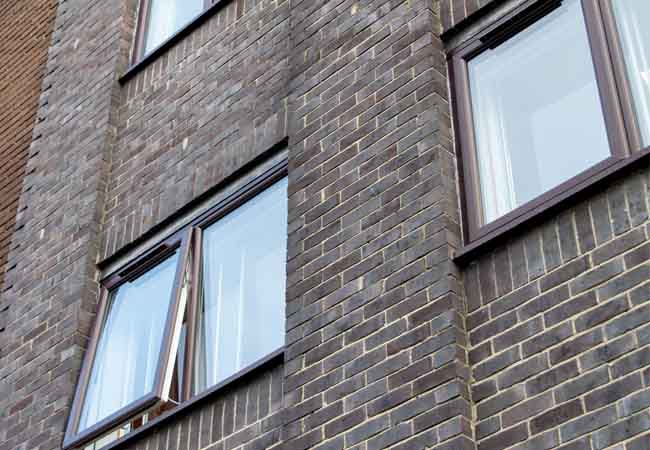
Watkins Payne’s 1970s office block is the first in the UK to be awarded a 5.5 Star NABERS UK rating
Crossing the threshold to 5.5 Stars
Having secured 5.0 Stars, the consultant used an advanced simulation model to identify the specific interventions required to bridge the gap to 5.5 Stars. The data suggested that a reduction in energy intensity of approximately 12% from the 2023 baseline was required.
The primary capital intervention during this phase was the replacement of the original single-glazed windows with double-glazed units. This significantly cut heat loss through the façade and improved occupant comfort. Crucially, the new windows were easier to operate, encouraging staff to use natural ventilation.
Simultaneously, the team refined the heating strategy for restroom facilities to minimise out-of-hours energy consumption. The impact of these measures is evident in the data for the rating period of November 2023 to October 2024, which showed that the project team had met its 5.5 Star rating target with a decimal tracking indicator of 5.51.
Constant vigilance is required for the rating to be maintained. For Watkins Payne, the Energy Champion is crucial in continuing a culture of energy efficiency.
The company maintained its 5.5 rating last November and with a higher decimal tracking indicator of 5.65 Stars. The improvement was driven by an increase in operational hours because the energy intensity has remained almost flat, projected at 75.6 kWh.m–².compared with the previous year’s 75.7 kWh.m–². Because the NABERS algorithm normalises for hours of use, the building is being rewarded for maintaining its efficiency profile while servicing a longer operational week.

New double-glazed windows encourage staff to use natural ventilation
The path to 6 Stars
The target has now been set on the pinnacle of the NABERS scheme: 6 Stars. The gap, however, is substantial.
To achieve it the Sunbury office must reduce its annual energy consumption to approximately 32,249 kWh. This represents a further reduction of roughly 31% from its current performance level. With the fabric and primary lighting already upgraded, the ‘easy’ wins are gone. The strategy must now shift from demand reduction to generation and granular control.
The consultancy has identified four key ‘improvements’ to bridge this gap:
1. Onsite generation: Since it’s last certification, 41 solar panels have been installed on the roof with a total capacity of 21kW peak, delivering an estimated 13,075kWh of annual solar electricity generation (after losses). This is expected to meet around 25% of the building’s annual electrical demand. For a Whole Building rating, renewable energy generated and consumed on site is deducted from the Grid electricity import. This directly lowers the ‘electricity equivalent energy’ figure used for the rating calculation.
2. Granular metering: To squeeze out the remaining inefficiencies, the firm plans to upgrade metering to provide detailed monitoring of major consumption sources.
3. Smart power control: Small power loads are often the ‘silent assassins’ of energy ratings. The next steps include the installation of smart sockets to monitor and control small power loads, specifically targeting the elimination of standby loads.
4. Refined heating: Further updates to heating controls are planned, specifically to minimise out-of-hours use in peripheral areas like toilets.
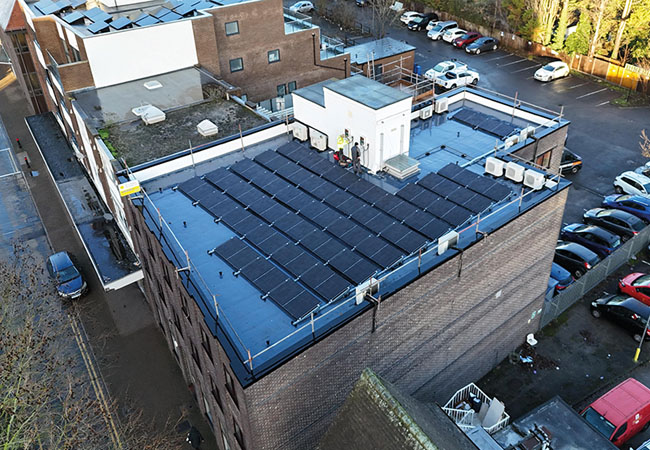
Solar panels are expected to meet around 25% of the building’s annual electrical demand
Lessons for industry
The success of the Sunbury office offers a validation of the NABERS ‘Design for Performance (DfP)’ ethos. DfP is the framework NABERS created to ensure buildings in operation achieve their design target. Watkins Payne has demonstrated that retrofits do not always require a complete strip-out or a new façade. Instead, a combination of targeted fabric upgrades (glazing), systems modernisation (LED lighting and controls), and crucially, occupant engagement (energy champions), can deliver world-class performance.
As the UK industry faces the challenge of stranded assets and tightening MEES Regulations, this journey proves that the path to 5.5 Stars is open to the buildings of the past, provided they are managed with the precision of the future