
Decarbonising the built environment is no longer a theoretical challenge. For most building services engineers, it is now a defining feature of everyday practice. According to a new survey, sustainability is important in the current projects of 91% of respondents. While policy ambition and client ambition are accelerating, however, delivery on the ground remains constrained by a combination of technical, commercial and organisational barriers.
The survey, with more than 250 responses – brought to you by CIBSE Journal and intelligent power management company Eaton – offers a revealing snapshot of how the industry is grappling with the challenges of delivering net zero carbon buildings.
An experienced profession under pressure
The survey respondents are predominantly senior, experienced practitioners. More than half have worked in building design or consultancy for 20 years-plus, and a further 22% for 11–20 years.
Most respondents work across M&E disciplines, with HVAC, power and lighting systems most frequently specified. This cross-disciplinary exposure is important, because decarbonisation increasingly cuts across professional boundaries. Decisions about heating systems, electrical infrastructure, controls and resilience are now tightly interlinked. This depth of experience lends weight to the findings: nearly half are long-standing practitioners reflecting on a system that is changing fast.
When asked to rank the biggest challenges they face in building design projects today, pressure to reduce project timelines and costs emerged as the most significant issue overall.
Budget constraints and changing client expectations followed closely behind, with poor stakeholder communication ranking highly. Staff shortages, while often cited in industry forums, ranked lower than might be expected.
Electrification is widely recognised as central to decarbonising buildings, particularly through the replacement of fossil fuel heating with heat pumps and the expansion of electric vehicle (EV) infrastructure. However, the survey highlights just how challenging this transition is in practice.
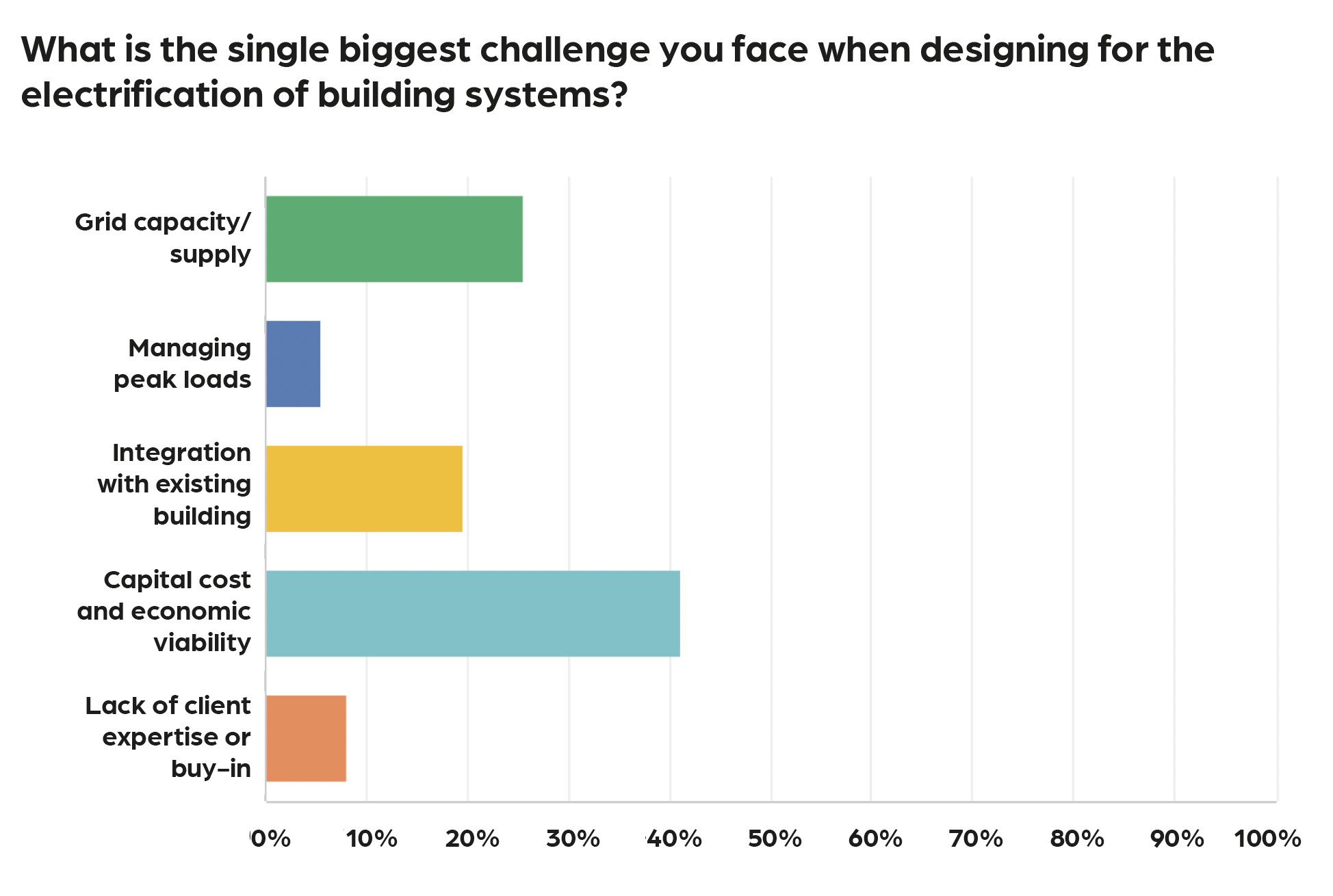
When asked about the single biggest challenge in designing for electrification (see graph below), capital cost and economic viability topped the list, cited by more than 40% of respondents. Grid capacity and supply constraints followed, while integration with existing building fabric and space limitations also featured strongly. Responses included: ‘Lack of carbon literacy and skills shortage on every level’; and ‘Unsuitable codes and standards’.
These findings point to a disconnect between policy ambition and physical reality. While electrification is often presented as a straightforward substitution, practitioners are grappling with buildings and networks that were never designed for today’s electrical loads.
Retrofitting heat pumps into constrained plantrooms, accommodating new risers or substations, and negotiating with network operators over connection capacity are now routine challenges.
Given that Grid capacity was identified as a major challenge, it is surprising that only a small minority of respondents are actively integrating distributed energy resources (DERs) – such as battery storage, solar PV and EV charging – into their designs today, with most reporting relatively low levels of adoption.
Marc Gaunt, sales director, commercial buildings, UK & Ireland, at Eaton, points to a recent retail project as an illustration of what is possible. The 2,320m² store faced a fixed 250kVA Grid supply limit that could not meet its operational needs, even after significant efficiency improvements.
Using Eaton’s Building as a Grid Simulator, the team modelled real-world energy flows and identified a battery-based approach to bridge the gap. A 200kW/750kWh containerised xStorage system was installed externally, and integrated with the site’s switchboard and distribution infrastructure to provide peak shaving and maximise the store’s consumption of energy generated by large onsite solar panels.
Respondents expect digital technologies to have a significant impact on their work over the next two years. Energy consumption forecasting, artificial intelligence, smart sensors and battery energy-storage systems all featured prominently. Building performance simulation tools also ranked highly, reflecting the growing need to model buildings dynamically.
Sustainability now mainstream
Green building practices are now firmly embedded in mainstream design. Yet the survey suggests this does not automatically translate into clarity. When asked how the push for net zero carbon buildings has most significantly impacted electrical infrastructure design, respondents pointed to a wide range of factors: embodied carbon in materials, system sizing for higher peak loads, integration of renewables and storage, operational performance, and product longevity (see graph below).

This breadth of impact reflects the complexity of net zero itself. Engineers are no longer optimising for a single parameter, such as capital cost or energy efficiency, but balancing multiple, sometimes competing, objectives across the building life-cycle. Without clearer guidance and consistent metrics, this complexity risks slowing progress, rather than accelerating it.
Alongside decarbonisation, power resilience remains a major concern. More than 80% of respondents rated resilience as very or moderately important when specifying systems for clients. This highlights an emerging tension within building services design. As buildings electrify and rely more heavily on digital systems, their vulnerability to power disruptions increases. Engineers are therefore being asked to square a difficult circle: deliver low carbon buildings that are also robust in the face of Grid instability, extreme weather and changing patterns of use.
At the same time, traditional resilience solutions – such as diesel generators – sit uneasily with decarbonisation goals, although solutions such as battery storage and smart load management can help keep buildings and systems operational.
Knowledge gaps and the skills challenge
Despite the experience of the respondent group, significant knowledge gaps remain. Smart grid integration, demand-side and microgrids were all identified as technologies that represent the most significant current knowledge gap in design teams. DC distribution and battery energy storage also featured highly.
This is not a criticism of practitioners, but an indication of how fast the landscape is shifting. Many of these technologies are still evolving, with limited guidance, few exemplars and inconsistent client demand. Without structured knowledge sharing and professional development, there is a risk that innovation will outpace competence.
The findings point to a profession broadly aligned on the need for change, but stretched by competing pressures: electrification, Grid constraints, skills shortages, cost volatility, and the pace of regulatory and technological change.
Perhaps the most striking finding is not any single challenge, but the cumulative effect of many placing unprecedented demands on building services engineers.
Yet the survey also suggests a profession that is embracing these challenges. The message is clear: decarbonisation is not being resisted on technical grounds, but constrained by systemic issues that require coordinated action. Policy, regulation, education, client leadership and infrastructure investment need to move in step.
The findings reinforce the importance of professional guidance, knowledge sharing and advocacy. Engineers are ready to deliver low carbon buildings, but they cannot do it alone. The next decarbonisation phase will be defined by how effectively the industry tackles the practical realities revealed by this survey.
Survey details
CIBSE Journal received 250 online responses between December 2025 and January 2026