
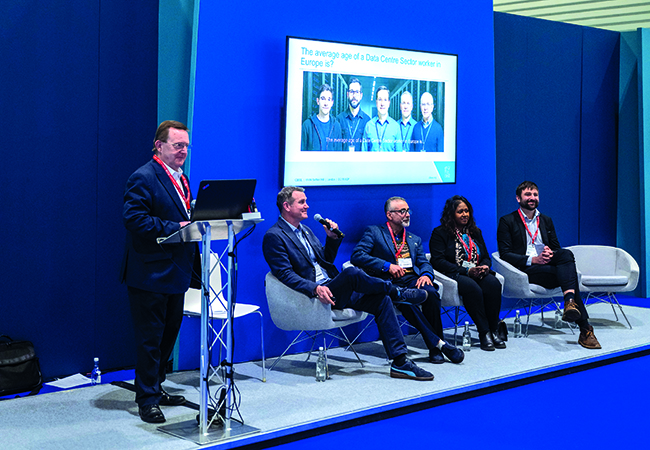
The CIBSE Data Centre Group panel session
CIBSE had a substantial presence at the elementalLONDON exhibition and conference last month. There were two dedicated Build2Perform theatres, featuring expert speakers, from across industry, who presented on topics ranging from decarbonisation and building performance to indoor environmental quality and inclusivity in the workplace.
Among the highlights was a packed panel session hosted by the CIBSE Data Centre Group. It delved into the challenges and opportunities of this fast-evolving sector, and explored three of its most urgent talking points: the need for new, future-proof technical guidance; the recruitment crisis; and the speed of technological change driven by AI. The group aims to provide authoritative guidance, share emerging knowledge, and support best practice in data centre design and operation.
Iain MacDougall, head of sustainability solutions at Red Engineering, highlighted that, in 2024, the UK’s data centre MEP value surged to £1.05bn – 60% larger than the office sector. With AI rapidly reshaping and expanding digital infrastructure, MacDougall said the group has identified areas of research necessary to address emerging challenges.
Heat recovery and sustainability were recurring themes. MacDougall noted that ‘everyone has tried it; very few have prevailed’, and he stressed the need for frameworks that work in both political and technical realities.
TM65 is increasingly central to guiding reductions in embodied carbon as facilities grow. ‘An incredible amount of earth materials [including rare earth materials] go into data centres. I’d like to see dedicated TM65 for data centres,’ said Mohammad Royapoor, head of R&D at Red Engineering.
Energy efficiency and net zero strategies remain urgent. Austin Williamson, technical director at Foreman Roberts consulting engineers, stressed that data centres cannot function without reliable power, yet they face mounting pressure to reduce carbon footprints. He pointed to the need for systems that can deliver resilience while cutting emissions, which will involve redesigned power-distribution networks, microgrids and, potentially, small modular reactors.
Liquid-cooling research
Liquid cooling is a major emerging frontier. Felix Cox, mechanical engineer at Aecom, described the industry as being in a period of ‘exciting technological evolution, driven primarily by AI workflows and large language models’. With minimal existing guidance, the group’s liquid-cooling workstream aims to establish best practice on temperature ranges, coolant media, filtration and design principles.
As innovation accelerates, however, the workforce is struggling to keep pace. With the average EU data centre professional now aged 53, MacDougall warned of an impending skills gap.
Shabna Hayes, regional director at Aecom, added that women remain severely underrepresented within the sector, making up just 8% of the workforce. ‘We need to create more awareness of recruiting a wider range of individuals into the sector,’ she said.
CIBSE President Vince Arnold gave a keynote on some of the major themes of the event, including the use of AI, retrofitting, decarbonisation, and the transition to low carbon heating and electrification. He stressed the importance of human-centred approaches, including diversity and inclusion, and said catering for a range of populations is essential for a resilient, high-performing built environment.
Inclusive engineering
The importance of inclusion was reinforced in a CIBSE debate on neurodiversity. The panellists stressed that inclusivity is a moral and ethical necessity that also leads to more profit, as having diverse patterns of thought results in more diverse solutions.
Naomi Jackson-Macfarlane, student wellbeing adviser at Imperial College London, highlighted the issue of intersectionality, where barriers are amplified for neurodivergent people from marginalised backgrounds.
Panellists offered solutions on creating a supportive culture. Past CIBSE President Andy Ford FCIBSE encouraged employers to ‘get people talking to each other’ and provide opportunities for open communication.
Chris Openshaw, co-chair of Divergent at Cundall, agreed: ‘Knowing there are people similar to you makes people feel recognised and seen.’
Workspace adjustments were discussed – such as noise-cancelling headphones, less visual distraction and quiet areas – and Chloe Agg FCIBSE, engineering lecturer at Imperial College London, emphasised the power of individual action: ‘Offer kindness – it’s brilliant for neurodiversity and others.’
For more on the CIBSE Data Centre Group, visit bit.ly/CIBSEDataCentres