

CPD sponsor
The UK government has an ambition for 20% of the nation’s heat to be provided from heat networks by 2050 (up from 3% in 2024), as part of the nation’s transition to net zero by 2050.1
Heat networks distribute heat or cooling from centralised sources to a variety of different customers, such as public buildings, shops, offices, hospitals and homes.
Whether supplying a few neighbouring buildings or entire cities, these centralised systems remove the need for individual boilers or heaters in each building connected.
A major appeal of heat networks is that they can take advantage of a wide array of different heat sources – including the recovery of low carbon heat from sources such as industry and data centres that would otherwise be wasted, along with naturally occurring sources, such as geothermal or rivers.
While the government’s heat ambition is admirable, the problem is that many existing heat networks are, according to its research, operating ‘sub-optimally’, to the detriment of customers, ‘particularly where networks operate at lower efficiencies and increasing fuel costs are passed through’.2
To support the delivery of net zero and ensure a more efficient energy system, the government introduced the Energy Act, which became law in 2023. This included powers for government ‘to mandate heat network technical standards in Great Britain through regulations’.3
These regulatory technical requirements for heat networks are expected to be introduced in forthcoming regulation. In advance of this, the government will be publishing a mandatory Heat Network Technical Assurance Scheme (HNTAS), which aims to ensure new and existing heat networks achieve minimum levels of performance and reliability. It is aimed at parties engaged in planning, construction, management, operations and maintenance of heat networks. The HNTAS documentation, written by specialist energy consultancy FairHeat, will be phased in over time to ensure the sector has sufficient time to ‘shape, understand and comply with the scheme’.
The first tranche of these documents has been published in draft form: there are overview documents covering the new build technical specifications and assessment procedures for the six major elements of a heat network: the energy centre; district distribution network; substation; communal distribution network; consumer connection; and consumer heat system.
This CPD sets out to describe the new HNTAS scheme and outline how, in particular, it is expected to work for heat interface units (HIUs) and substations.
The need for change
A fundamental change to the regulatory landscape is required for heat networks to achieve their decarbonisation potential. This is driven by the need for enhanced consumer protection, as customers connected to a heat network are obligated to use a single heat provider, contrasting sharply with the competitive market available to those using independent heat sources, such as heat pumps or gas boilers.
The new regulatory framework mandates reliable heat and hot-water supply at fair prices, a core measure the government anticipates will boost heat networks’ appeal and drive market expansion. The mandatory HNTAS scheme is intended to ensure heat networks achieve minimum levels of performance. The government also expects that in a regulated sector, where standards are harmonised, heat networks will become a more attractive investment proposition for asset managers.
Energy regulator Ofgem will be responsible for regulating the sector and monitoring heat networks’ compliance with the regulatory framework. Its role will include: managing the authorisation regime; ensuring compliance with consumer protections; and managing audits and enforcement activity where necessary.
Performance-based assurance
HNTAS is a performance-based assurance scheme. For each element, assessments against minimum standards are made at various life-cycle stages of a heat network. For example, in the design and construction stages, assessments will be made to validate the claims that certain performance outcomes will be achieved. Similarly, on commissioning, assessments will verify that performance outcomes have been achieved and maintained.
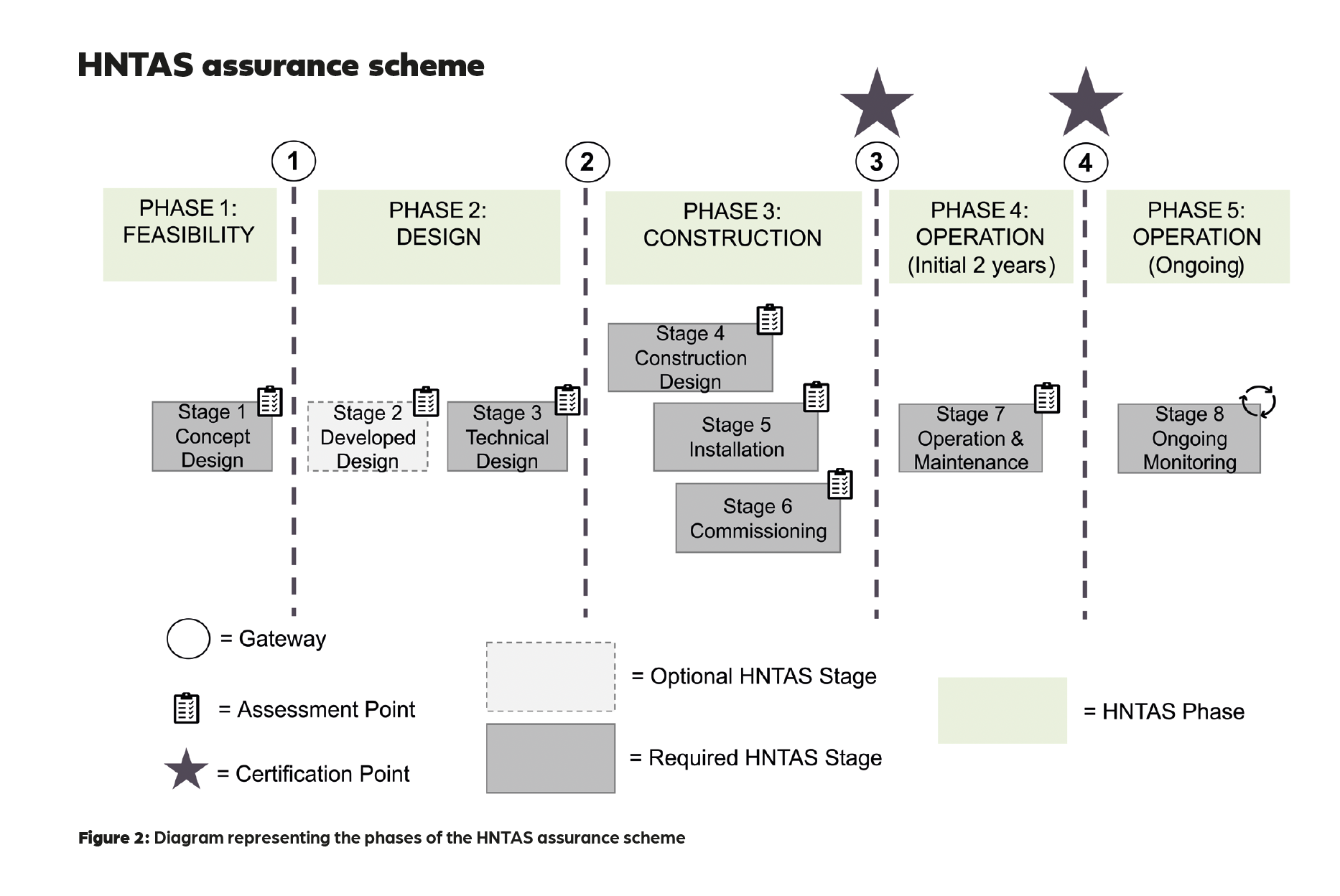
For new networks, an assessment pass will be required at three key gateway points in a heat network’s life-cycle: before a network is allowed to start design; before starting construction; and before starting operation
An assessment pass will also be required after two years of operation to ensure that performance levels continue to meet requirements (see Figure 2).
Technical requirements
The first HNTAS technical specification documents4 detail the technical requirements to be met for the six elements of a heat network; outline performance monitoring requirements; detail key failures to be avoided at each stage; and evidence requirements to be provided to demonstrate conformity with HNTAS and avoidance of key failures.
All technical requirements are derived from existing industry documentation. The primary reference is the CIBSE Code of Practice CP1 (2020), which provides the foundational technical standards for the regulations.5 For topics not covered by existing industry documentation, additional technical requirements have been added to address these gaps.
A new Heat Network Technical Standard (HNTS) is being developed and will be published later this year. This will supersede CP1, and will be used as the predominant technical standard referenced in HNTAS.
KPIs
The HNTAS technical specification overview documents contain the key performance indicators (KPIs) to be achieved and maintained in operation for each element of a network. These build upon and formalise the KPI concepts outlined in CP1 (2020). While both documents emphasise the importance of performance monitoring, the HNTAS draft provides a more prescriptive and detailed framework for KPIs.
The KPIs are split into two types:
- Assessed KPIs: these are KPIs that are assessed against predetermined targets at commissioning, and throughout the operation and maintenance phase, in order to achieve and maintain HNTAS certification.
- Reported KPIs: these are KPIs that are not assessed against a predetermined target through the operation and maintenance phase, but still provide valuable information, so are to be reported in the same format.
As an example, the draft overview technical specification document for consumer connection (HNTAS-TS-CC-P0) lists 13 assessed KPIs. KPI 1 relates to the automatic remote monitoring system (ARMS) connectivity. It explicitly measures ARMS connectivity and data completeness, with set percentage targets given at the commissioning stage (100% connectivity) and the operation and maintenance stage (≥99% connectivity).
Assessment procedure
Alongside the HNTAS technical specification overview documents, the government has published six corresponding assessment procedure documents in draft form.6 Each document details the activities to be undertaken to provide assurance that the obligations in the corresponding technical specification document have been fulfilled.
Further draft technical specifications and assessment procedures for new-build networks and for existing networks will be published at a later date. In total, there will be 34 technical specification documents published and 34 corresponding assessment procedure documents.
While a total of 68 documents may, at first, appear to be overwhelming, the documents are organised logically for each of the six elements, with subsequent documents corresponding to each phase of a heat network’s development and operation for each element (see Figure 2).
In addition, there will be five supplementary specifications detailing the requirements for acceptance testing for the different elements. Final versions of all documents will be available once the scheme is live in 2026.
The optimisation of substations and consumer systems
With more than 50,000 HIUs being installed each year in the UK, setting performance standards has become increasingly important in supporting the deployment of low carbon heat networks. HIUs function as the critical interface between the heat distribution network and the consumer’s heating system.
The Building Engineering Services Association (BESA) UK HIU Test Regime publication7 aligns closely with the objectives and specific technical requirements of the draft HNTAS, particularly concerning the performance of consumer connection elements, which typically include HIUs.
The aim of the document is to introduce a pragmatic and practical way of testing and comparing HIUs, to provide a basis for assessing performance for those developing and designing heat networks.
The performance metrics defined in the BESA test standard align with the assessed KPIs set out in the draft HNTAS-TS-CC-P0 for volume weighted average return temperature (VWART) and standing heat loss.
The performance of substations, too, is important in optimising the performance of heat networks (see Figure 1). The substation provides the connection between the district heat distribution network and the consumer distribution network.
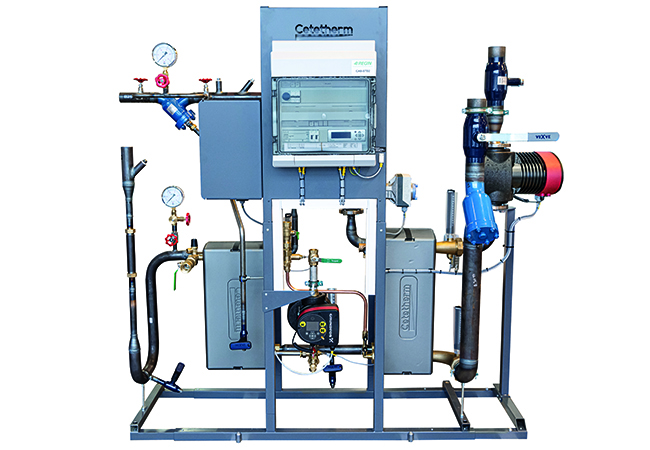
Figure 1: District heating substations are available to meet a variety of sizes, scope and requirements
The document HNTAS-TS-SS-P0 specifies several KPIs to ensure a substation efficiently transfers heat and maintains predictable flow conditions. To assess these KPIs, substations must use a metering and monitoring system, which records data at least every five minutes for flow, temperature and pressure points, and at least every 30 minutes for heat meters and water meters. The required substation monitoring points are set out in HNTAS-TS-SS-P0.
Legacy systems
There are around 14,000 heat networks in the UK, but government-funded analysis over the past decade has revealed a myriad of issues affecting performance that risk undermining the government’s goal of providing affordable, low carbon heat. The most frequent are listed in the panel ‘16 common reasons for the failure of legacy heat networks’.
16 common reasons for the failure of legacy heat networks
- Insufficient consideration of heat network requirements at concept design stage
- Incorrect sizing
- Unnecessary complexity
- Unsuitable hydraulic arrangement
- Poor insulation specification and installation
- Poor planning and civil works for underground pipework
- Poor underground pipework installation
- Insufficient monitoring and data collection
- Inappropriate design and commissioning of consumer connection and/or heat system
- Lack of consideration given to system pressures
- Lack of consideration given to maintainability
- Poor installation and commissioning practices
- Inefficient control
- Uncontrolled network flows
- High return temperatures
- Poor water quality
Heat network customers are unable to shop around for alternative suppliers and many – especially those using older and less efficient networks – may be paying more for their heating as a result.
Under the HNTAS scheme, existing networks will have to meet (yet to be published) performance requirements. However, the government says there will be a ‘significant’ transition period to allow operators to ensure appropriate metering is in place to be able to prove performance. It also says the performance requirements for existing systems will be set at ‘a more permissive level’ than those for new networks, and that operators will ‘be given time’ to reach these.
The Heat Network Optimisation Guide,8 published in 2023, is expected to be used as the basis for setting performance requirements for legacy systems. As such, it provides a standardised set of processes and approaches that anyone undertaking optimisation can use, with the aim of providing a minimum quality standard.
The guide recommends taking a four-stage phased approach: understand, stabilise, easy wins and continuous improvement. Once root causes have been understood, the stabilisation of a heat network should take place to improve performance and reliability. Easy wins can then be carried out that have short payback times but require more planning and design. The continuous improvement cycle is designed to enhance performance over a long period. It has four repeating stages – measure, analyse, test and implement.
The guide outlines KPIs for quantitative analysis of heat network performance using data from the building management system, heat meters and utility bills, which may form the basis of the HNTAS legacy system performance requirements.
HNTAS certification
Once a new or existing heat network has passed all assessments, it will be awarded a HNTAS certificate as evidence of compliance. The heat network operator will be required to ‘regularly submit data’ to a HNTAS digital portal to show that the network continues to meet the HNTAS KPIs. This should ensure that more heat networks run efficiently and help the technology support the delivery of net zero.
© Andy Pearson, 2025.
References:
1 UK heat networks: market overview – bit.ly/CJNov25CPD41.
2 Heat Network Efficiency Scheme (HNES): overview – bit.ly/CJNov25CPD42.
3 Heat Network Technical Assurance Scheme (HNTAS) – bit.ly/CJNov25CPD43.
4 Heat Network Technical Assurance Scheme (HNTAS): technical specifications – bit.ly/CJNov25CPD44.
5 CP1 Heat networks: Code of Practice for the UK (2020) – bit.ly/CJNov25CPD45.
6 Heat Network Technical Assurance Scheme (HNTAS): assessment procedures – bit.ly/CJNov25CPD46.
7 BESA Technical Standard For UK HIU Test Regime – bit.ly/CJNov25CPD47.
8 Department for Energy Security and Net Zero, Heat Network Optimisation Guide – bit.ly/CJNov25CPD48.