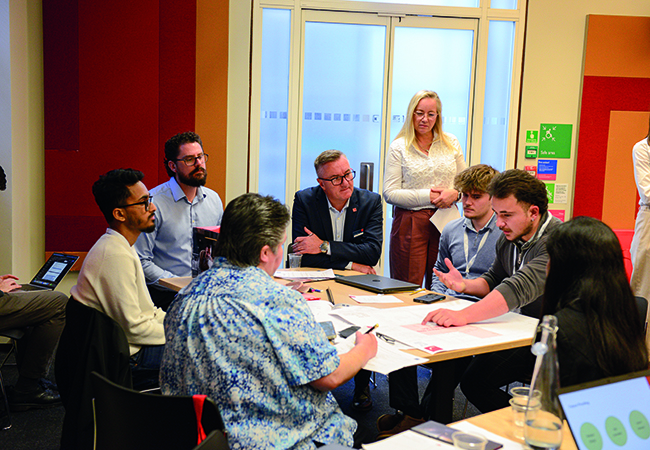
The winning team, High Spec, present their solution to the judges
Young engineers are stepping up to shape the future of healthy, comfortable and sustainable buildings. Indoor environmental quality (IEQ) – vital for occupant health, comfort and productivity – was at the heart of a new hands-on challenge to inspire the next generation of building services professionals.
On 9 October, graduate, undergraduate and apprentice engineers, along with those in the first 10 years of their careers, gathered at UCL’s Senate House for the first CIBSE Journal and Zehnder Group UK Young Engineers IEQ Design Challenge. The event invited participants to compete in an engaging design exercise, with a £2,000 prize up for grabs. The challenge formed part of the celebrations marking 30 years of the CIBSE Young Engineers Awards.
Teams were asked to design and model an indoor space, with a focus on wellbeing and IEQ. It was an opportunity to apply technical knowledge in a practical context that encouraged problem-solving, innovation and teamwork.
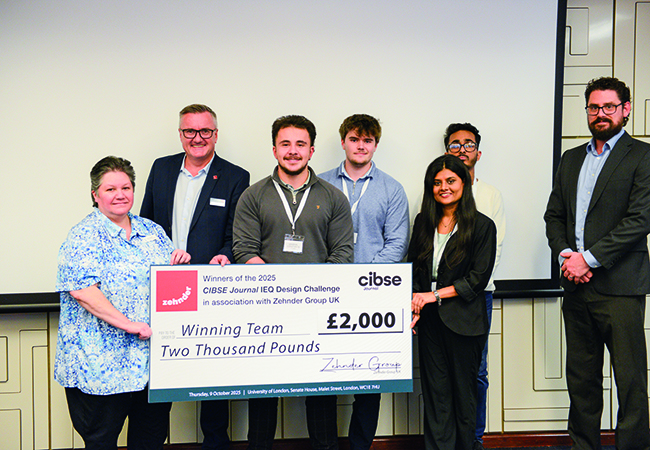
Zehnder’s Stuart Smith presents the £2,000 prize, with fellow judges Ellen Salazar and Adam Taylor
Stuart Smith, commercial director at Zehnder Group UK, kicked off the day by emphasising the importance of holistic design. ‘We need to be more thoughtful about the indoor environment and ensure that the systems that go into it work in harmony. IEQ encompasses air quality, thermal comfort, acoustic comfort – even visual comfort,’ he said.
Smith outlined why it is vital to understand and consider IEQ in projects. ‘Our buildings are more airtight than ever, trapping pollutants as well as heat, but without effective ventilation and the right balance of heating systems this can lead to huge issues with damp, mould and overheating. Poorly controlled environments cost more, can damage the fabric of the building, and impact occupant health.’
Nicola Rivers, climate division head at Zehnder Group UK, echoed this. ‘Part O of the Building Regulations and overheating go hand in hand with IEQ. Since the regulation was launched in 2022, alongside Part L and the London Plan, engineers have had to consider modelling for almost every property type.’
Click here to watch the video, which showcases highlights from the day:

The challenge
The task was to design a ventilation and heating solution for a two-bedroom apartment on the second floor of a 15-storey city centre tower. The building faced multiple environmental challenges: a main road outside, a bus stop, nearby nightclubs and restaurants, and south-facing windows. Although insulated to Part L standards, the apartment had already failed TM59 and Part O assessments.
Teams had to address four critical IEQ domains: indoor air quality (IAQ), and thermal, acoustic and visual comfort, with priority given to IAQ and thermal comfort. Solutions needed to provide sufficient ventilation, regulate heating and cooling efficiently, mitigate noise and maintain visual comfort. Ceiling-void restrictions, duct sizing, noise and energy efficiency were additional constraints.
With just two hours to develop a solution, the six teams immersed themselves in the challenge, drawing on a blend of technical expertise, creativity and practical knowledge.
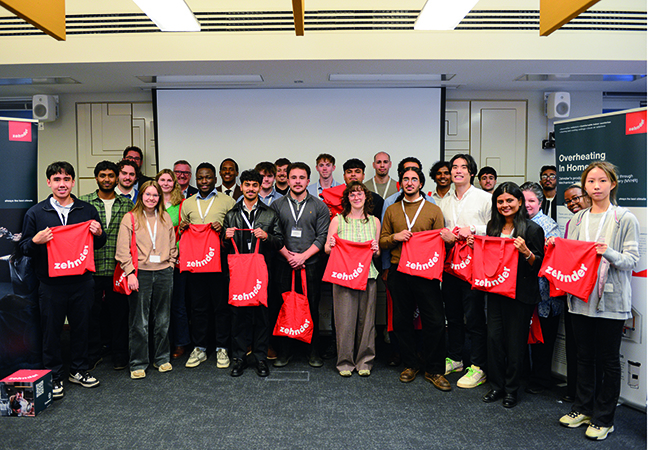
Six teams of young engineers competed in the Design Challenge
Henry Ibitolu, a recent PhD graduate in net zero building engineering from the University of Edinburgh, said that the day was ‘very intellectually challenging and a great networking opportunity’. Although his area of expertise isn’t IAQ, he had ‘learned some fascinating things about HVAC systems and how they come together to create a comfortable indoor environment’.
The event tested participants’ communication and problem-solving skills, and Ikechukwu Umeokoli – mechanical engineer at AtkinsRéalis – explained that it had prompted him to use information more efficiently. ‘We had to focus on picking out what was pertinent,’ he said. ‘It also emphasised how crucial it is to clearly communicate ideas to other engineers who may not share your specialism.’
The teams presented to a panel of industry experts – Adam Taylor, CEO at ARM Environments and chair of IAQ group, BESA, Ellen Salazar, head of building services at CIBSE, and Zehnder’s Stuart Smith – who evaluated each design on its creativity, feasibility and technical rigour.
Winning solution
Winning team High Spec – made up of Gabriel Constante, a mechanical design engineer at 361 Degrees, Deepsi Shah, studying for an MSc in environmental design of buildings at Cardiff University, Dylan Sanders, graduate mechanical design engineer at Derry Building Services, and Muhammed Nasir Islam, apprentice engineer at CC|BE – impressed the judges with a detailed, integrated approach to indoor environmental quality.
Their design centred on a smart building management system to monitor temperature, humidity, CO₂ and noise, automatically adjusting heating and ventilation through smart thermostatic radiator valves and automatic opening vent windows for adaptive night cooling.
A reversible heat pump was selected to provide heating and cooling without the need for an external condenser. In addition, argon-filled glazing, to limit solar gains, NOx filtration and acoustic attenuation were chosen to enhance air quality, comfort and sustainability.
‘The biggest challenge was making sure every aspect of comfort worked together without compromising practicality,’ said Shah. Constante added that the team ‘listed key objectives, brainstormed ideas and built a solution that considered every detail, from duct sizing to solar gain’.
Salazar was impressed by the participants, commenting that ‘everyone had generated very good solutions in a short time. The collaboration across teams was impressive.’
Taylor highlighted the high level of understanding on display: ‘The teams pulled key details out of the brief and translated them into coherent, consistent designs,’ he said. ‘IEQ is often overlooked because engineers work in silos. Encouraging young engineers to think holistically is vital. The winning team combined innovation with feasibility.’

Smith remarked on the depth of detail that emerged during the day. ‘The winning team really shocked me with the level of detail they considered in just two hours – from duct sizes to airflows. This shows how important it is to engage early with young engineers and give them opportunities to explore IEQ in depth.
‘There is so much potential here for the future of IEQ design.’