
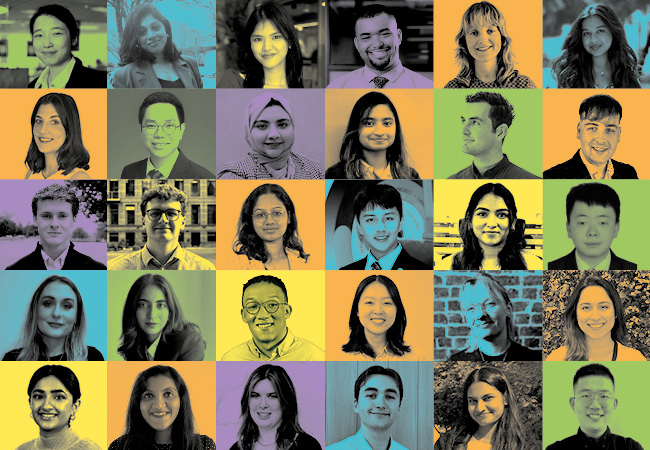
CIBSE launched its 30 Under 30 initiative last month, to mark the 30th anniversary of the Young Engineers Awards and celebrate early-career professionals who demonstrate exceptional talent and commitment to the future of building services.
The inaugural cohort represents a new generation of engineers: digitally fluent, sustainability-driven and unafraid to challenge traditional boundaries.
As artificial intelligence (AI) begins to reshape the built environment, we asked some of these 30under30 engineers what they believe AI will mean for the profession. Their responses reveal a group that is technically astute and ethically grounded, and optimistic about AI’s potential, yet clear-eyed about the responsibilities that come with it.
When asked to identify the single biggest benefit of integrating AI into building services engineering, most agreed it was efficiency and intelligence across every stage of a building’s life.
‘AI enables multiple-objective optimisation in building performance, by analysing data points that can be assessed to balance energy, carbon, cost, comfort and resilience simultaneously,’ explained Shweta Salvankar, Harley Haddow. ‘It allows faster design and operation decisions that achieve higher sustainability outcomes.
Zhengguang Liu, Department of Chemical Engineering, The University of Manchester said: ‘AI can continuously analyse building performance data – HVAC loads, occupancy patterns, weather forecasts, energy pricing – and dynamically optimise systems in real time. That means HVAC, lighting and power systems run only as much as needed, predictive maintenance prevents wasteful breakdowns, and energy use is balanced with renewables and storage.’
For Aashika Shibu, Etude, the transformative potential of AI lies in optioneering. ‘It can rapidly test thousands of design variations, materials, systems and layouts, and highlight the smartest pathways for efficiency, cost and carbon.’
The benefits extend to retrofit projects, too. ‘AI will improve efficiency in all stages of the design process, particularly in optioneering retrofit interventions for existing buildings through data-driven insights, and greater automation in reporting, specification development and design briefs,’ said Sehrish Wakil, Historic England.
Several respondents believe AI will make buildings adaptive, rather than static. ‘The biggest benefit of bringing AI into building services engineering is that it makes buildings smarter about energy without sacrificing comfort. Instead of systems running on fixed schedules or broad assumptions, AI learns from real-time data – how people actually use the space, what the weather’s doing, even when equipment is starting to wear out – and then makes the right adjustments on its own. That means lower energy bills, fewer breakdowns and more comfortable environments, all at the same time,’ said Yusra Oosman, Manipal University Dubai.
For engineers, this shift marks the move from designing efficient buildings on paper to creating living, adaptive systems that remain efficient throughout their lifetime.
AI was viewed by the focus group as a way of freeing up engineers’ time. ‘The ability to sharpen our digital tools with AI to do more mundane tasks – data extraction, processing, verification – would be extremely useful. It would allow us to focus on larger solutions, such as the circular economy or scaling up reuse strategies to fast-forward the transition to a carbon-neutral economy,’ said Sundara Gurushev, Madaster.
AI’s potential to override user error was mentioned more than once. ‘In building energy controls, boilers can often be left on manual because users don’t understand the system. Using AI will optimise heating schedules and reduce that waste,’ said Sophie Sibley, Synergie Environ.
The evolving role of the building services engineer
With such rapid technological change, we asked the group to consider how the profession will evolve over the next decade.
‘Engineers will increasingly act as strategic overseers, with AI serving as an efficient assistant to process vast datasets and deliver better modelling,’ Salvankar said. ‘This frees us to focus on interpreting insights, integrating systems, and driving innovation towards net zero faster.’
In other words, the engineer’s expertise will lie less in routine modelling and more in making informed decisions about what those models reveal.
‘In the next decade, engineers will spend far less time hunting for thermal bridges or manually tweaking energy models – AI will spot those weak points in seconds. Instead, we’ll focus on weighing up trade-offs between efficiency, comfort and embodied carbon, making sure AI’s “optimal” solution actually works for people using the space,’ says Shibu.
Oosman described a shift from reactive problem-solving to proactive system leadership: ‘Instead of routine monitoring or fixing issues after they happen, engineers will be focused on designing and guiding intelligent systems that manage that automatically. AI takes care of fine-tuning, while we focus on the bigger picture – people, comfort, health and sustainability.’
There was also agreement that AI will transform how the industry manages carbon reporting and life-cycle analysis.
‘AI should allow engineers to capture, analyse and verify emissions information across the entire building life-cycle. That means not just smarter buildings, but smarter decisions that directly support the journey to a more carbon-neutral world,’ says Gurushev.
Ethics, accountability and new skills
Despite enthusiasm for automation, the engineers were clear that human oversight remains essential.
‘AI can suggest designs, but engineers will remain accountable for compliance with safety standards, and ensuring that automated systems are transparent and ethical. The role will be less about drawing ducts and more about setting guardrails for AI,’ says Liu.
This evolution will demand new competencies across the profession.
‘Similar to the upskilling required during the introduction of BIM, AI will demand data literacy, digital modelling, cybersecurity awareness, and the ability to interrogate AI outputs,’ Wakil noted. ‘Data security and the energy requirements of large-scale AI will also need careful attention.’
Ultimately, the group sees AI not as a replacement, but as an enabler. Wakil concluded that ‘You still need human involvement when designing systems for buildings that people occupy every day. AI will elevate engineers into better strategic integrators of intelligent, sustainable and occupant-focused environments. The profession won’t just survive the rise of AI; it will thrive because of it.’