
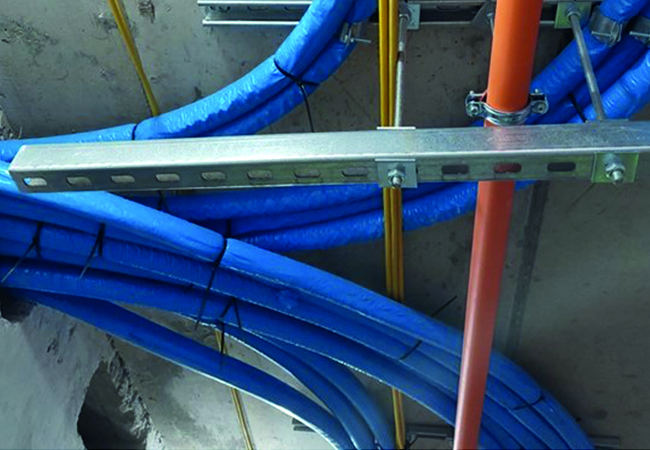
A polyethylene pre-insulated MLCP pipework installation
The construction industry is entering a period of heightened scrutiny. With publication earlier this year of the Construction Products Reform Green Paper, and a new construction products code of practice (PAS 2000:2026 Construction Products – Bringing Safe Products to Market) under development, questions are being asked about how products are designed, tested and specified.
The Green Paper states, ‘the anecdotal evidence suggests that two-thirds of construction products are unregulated’.
Thermal insulation for pipework, for example, is subject to harmonised testing standards and can usually be specified against clear parameters. When thermal insulation products are hybridised with other products, however, a new product is created, for which no harmonised standard yet exists.
The Office for Product Safety and Standards has confirmed that drawing up a Declaration of Performance (DoP) for polyethylene pre-insulated multilayer composite pipes (MLCP) products is not possible using the existing standards, and they must not be accompanied by a DoP and should not have a CE mark affixed.
In the case of polyethylene pre-insulated MLCP products, lack of an established means of verification has resulted in major variation in manufacturer product information – a significant challenge for clients wishing to confirm compliance with specifications and standards.
The role of trade associations
Trade associations have been tasked with taking a lead on installer competence, and the Thermal Insulation Contractors Association (TICA) was among the first to complete a competence framework for the industry.
There is also a perception at policy level that trade associations will push construction product reform – but when it comes to hybridised products, it’s not that simple. A pre-insulated pipe is both a pipe and a thermal insulation product. If a product crosses trade boundaries, no single association can police it fully, leaving potential blind spots.
Competence
With two key exceptions – domestic plumbing and commercial refrigeration applications – all pipe insulation should be installed by a thermal insulation specialist.
Domestic plumbing and refrigeration, such as direct expansion, typically incorporate flexible foams that are relatively straightforward to install. Other HVAC applications usually require low-emissivity rigid insulation products that need specialist skills to install. Swapping out these products for an easily installed polyethylene product is likely to compromise both the thermal performance specification and the minimum reaction to fire specification.
Pre-insulated pipework is often marketed as ‘requiring no follow-on trades’ and is typically installed by non-specialists without adequate knowledge. Heating and plumbing contractors proposing these as a ‘value engineering solution’ risk putting themselves in the position of ‘unintended designer’.
Further, pre-insulated pipework products are typically marketed by manufacturers and distributors in the pipe and fitting market – rather than to specialists in the thermal insulation market – and the insulation element often appears to be a secondary consideration. By marketing these products, pipework manufacturers are unwittingly placing themselves in the position of ‘accidental manufacturer’ of an insulation product.
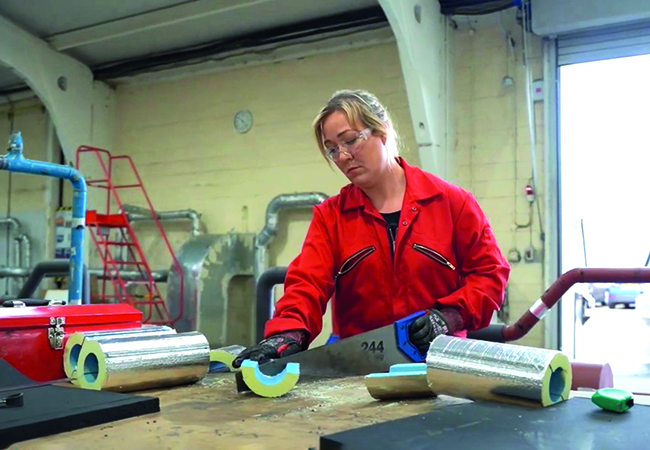
TICA is training the thermal insulators of the future
Reaction to fire
Polyethylene is combustible. It can be used safely in certain applications, but only if tested and certified appropriately. This is possible for standard polyethylene ‘pipe lagging’ because it is covered by the harmonised thermal insulation testing standards. However, polyethylene pre-insulated MLCP products are not.
The declared Euroclass reaction to fire for these products can vary anywhere between ‘B’ and ‘E’, suggesting there is a range of approaches to product testing. If a manufacturer is declaring a Euroclass B reaction to fire without an applicable testing standard as reference, its important to understand what that Euroclass B actually means and how the product is being tested.
Polyethylene pre-insulated MLCP products are treated with an additional polyethylene protective sheathing. It is often unclear whether the declared reaction to fire for the product is based on a test including the sheathing, or if it has been based on the existing polyethylene foam performance prior to alteration during the secondary manufacturing process.
When standard pipe insulation is tested to the harmonised standards, a minimum thickness of 25mm is required in a pipe insulation-specific ‘single burning item’ test rig. There appears to be no polyethylene pre-insulated MLCP systems on the market with an insulation thickness as high as 25mm and it is unclear how these products are being tested.
This is important, because many of these products are being marketed as having an equal reaction-to-fire value as traditional thermal insulation products, without evidence that they have been tested to the same standards.
Pre-insulated pipework products are manufactured with limited insulation thickness options.
There is a wide range of thermal insulation specifications, and a one-size-fits-all approach does not always allow for a diverse range of specification requirements to be met.
The thickness of insulation required to comply with maximum heat loss/heat gain depends on the thermal conductivity of the insulation.
Therefore, pipe insulation products with higher thermal conductivity (for example, polyethylene with a lambda value of around 0.038W.m-1.K-1 at 10°C mean) must be installed at greater thicknesses than pipe insulation products with a lower thermal conductivity (phenolic foam with a lambda value of around 0.025W.m-1.K-1 at 10°C mean, for example). In many cases, this makes polyethylene pre-insulated MLCP pipework unsuitable for anything other than small-bore domestic pipework.
Conclusion
Hybridisation can drive innovation, but if innovation outpaces testing standards, the resulting grey area is a very real liability for everyone involved in the supply chain.
Products spanning multiple trades are particularly at risk of falling into regulatory blind spots. Industry must collaborate to find these blind spots, and the chain between ‘accidental manufacturer’ and ‘unintended designer’ must be broken.
We need to ensure we stop non-compliant products making their way into our projects. Construction product-related regulations will help close the gaps, but this will take time. In the meantime, well-informed specifiers and consultants may be our best defence.
What can you do to help close the gaps?
- Be precise about the insulation material you wish to specify, confirming both reactions to fire performance and thermal performance.
- Consider dwelling vs non-dwelling applications, as standards differ.
- Specify that a suitably competent thermal insulation specialist carry out the work (excluding commercial refrigeration and domestic plumbing).
- Specify a particular table in BS 5422, rather than ‘insulate as per BS 5422’.
- Ask the manufacturer of the pre-insulated pipework product for a copy of the fire test report and seek further advice regarding suitability.
- Ask for manufacturer specific heat-loss calculations based on the specific parameters of the project and product.
About the author
Chris Ridge is technical director at the Thermal Insulation Contractors Association