
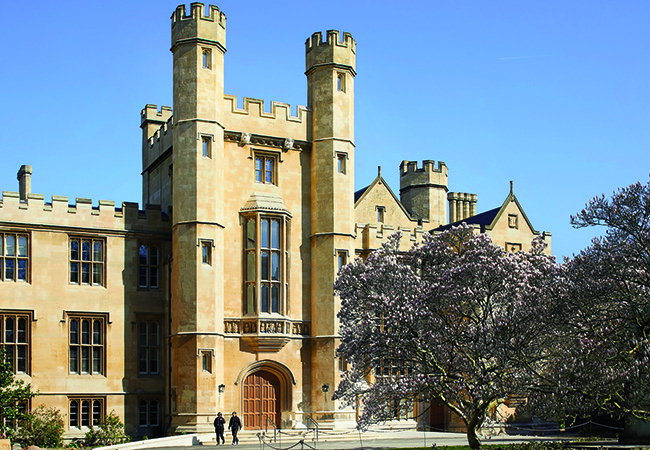
Future-proofing history: The Blore Building, dating from 1833, was included in the first phase of refurbishment, which took a fabric-first approach
In 2020, the Church of England’s General Synod voted to work towards the Church becoming carbon net zero by 2030 – an ambitious target for a body whose estate includes 20th-century village halls, Anglo-Saxon churches, medieval cathedrals and Victorian vicarages. So, how can it be transformed?
Two years after the Synod vote, work started on the £40m refurbishment of Lambeth Palace. As a demonstration project, it was extremely ambitious. Lambeth Palace is the Archbishop of Canterbury’s 800-year-old, Grade I-listed, Thames-side home. As well as incorporating the primary residence of the Church of England’s spiritual leader, the collection of buildings includes a Tudor gatehouse, 17th-century cloisters, and a Victorian function and administration block.
The task of transforming the estate was awarded to Arup, working with Wright & Wright Architects. They adopted a holistic approach to the palace’s transformation to show that it is possible to balance the need for preservation with the urgent requirement for energy efficiency.
The retrofit is the first major overhaul of the palace since works, in the 1950s, to repair bomb damage from the Blitz during World War II. Wright & Wright and Arup drew up a masterplan that, alongside sustainability, set out to improve accessibility. The challenge then was how to phase the works.
‘One of the principles we developed was to devise a methodology that meant we did not have to go back and do the same thing twice,’ says Edward Clarke, associate director at Arup. ‘It would be unforgivable to dig up the courtyard and then have to dig it up again.’
Phasing was made more complicated by the need to keep some spaces open throughout the works. ‘The brief was that the archbishop should have a residence available at all times, offices and spaces where he could entertain and meet people, and a place for prayer,’ Clarke explains.
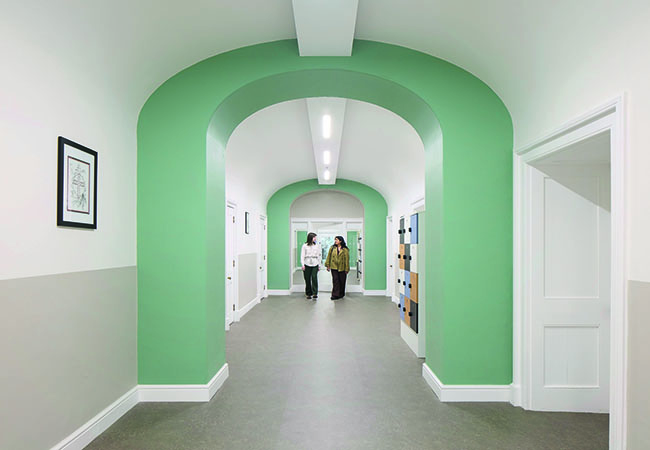
Worth the wait: The retrofit is the first major overhaul of Lambeth Palace since the 1950s
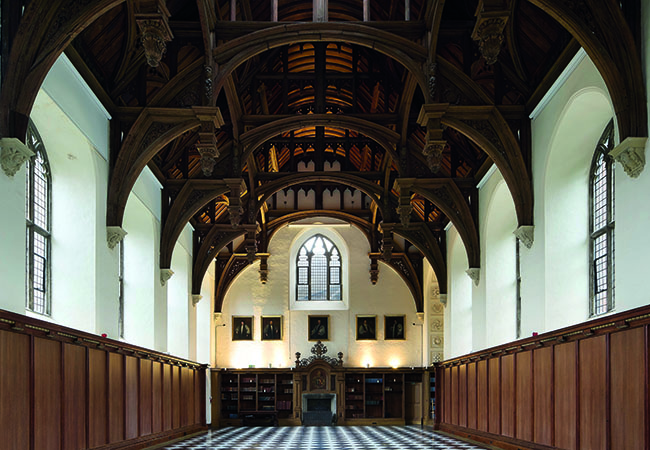
It was decided that the first phase should concentrate on refurbishing the 17th-century Great Hall and the 1833 Blore Building – the palace’s administrative hub – and include provision of the services for subsequent phases.
A 3D survey of the campus was carried out using a specialised 3D scanning camera that creates highly detailed digital twins of real-world spaces. This allowed the team to walk around the buildings virtually. The downside, however, was that the survey did not reveal the hidden services.
‘It can only show things that the lasers can point at it; sadly, it doesn’t include x-rays, so we sometimes had to guess where pipes were routed and the size of the risers, based on experience and from our conversations with the palace’s facilities management team.’
A low-pressure hot-water heating system served from gas boilers, hidden beneath the palace’s 13th-century chapel, provided heat for the complex. Clarke describes the system as ‘desperately inefficient’ with ‘a complete lack of controls’. From the subterranean boiler house, pipes followed ‘eccentric’ routes, crossing roofs and dropping down risers, to serve radiators warming the palace’s eclectic mix of buildings.
The refurbishment adopted a ‘fabric-first approach’ to reducing energy demand. This involved digitally modelling the building to decide where it was most cost-effective to improve fabric thermal performance. Installing loft insulation provided the ‘biggest bang for our buck’, according to Clarke, but the walls were left untouched: ‘You have stone on the outside and fine finishes on the inside, so there is no way of adding insulation – and, when the walls are 1.2m thick, adding insulation wouldn’t make that much difference in any case.’
Insulation was also added piecemeal to the ground floor. ‘If we were pulling up floorboards or lifting slabs, it was cost-effective to add insulation, but it wasn’t worth lifting slabs just to add insulation beyond 3m from the perimeter,’ explains Clarke.
The most significant energy efficiency improvement by far was replacing the windows. ‘The mock-Tudor windows looked historic, but were actually replaced in the 1950s after bomb damage; they should have been Georgian,’ says Clarke, who adds that Wright & Wright had a good relationship with the planners, so they were able to replace all 160 windows with high-performance sash windows. ‘That reduced energy demand by 41%.’
‘When the walls are 1.2m thick, adding insulation wouldn’t make that much difference’ – Edward Clarke
With the fabric improvements in place, a digital model was used to predict heat losses from each room. ‘We tested every room to see what the heat load would be. We took a fairly conservative view, particularly on the airtightness, which was difficult to evaluate,’ explains Clarke.
Having estimated the total heat load, Arup explored options for supplying the palace with low carbon heat. The site’s proximity to the Thames meant water source heat pumps were considered to extract heat from the river.
The consultant looked into drilling boreholes and installing a horizontal array in the palace’s large garden. Even solar thermal was considered. However, Clarke says ‘the winner by far’ was air source heat pumps (ASHPs), which were ‘locked into the design’ from its concept.
The scheme uses three 250kW ASHPs, which ‘provide enough heat for the entire site, with some spare capacity once the refurbishment has been completed’, Clarke adds. Any surplus could be used to heat the neighbouring Garden
Museum.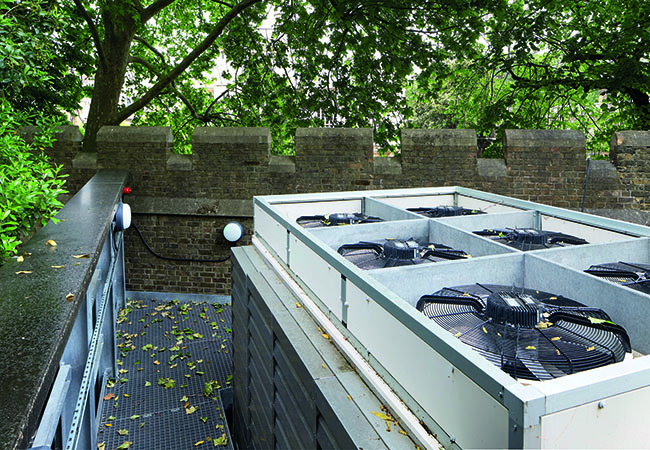
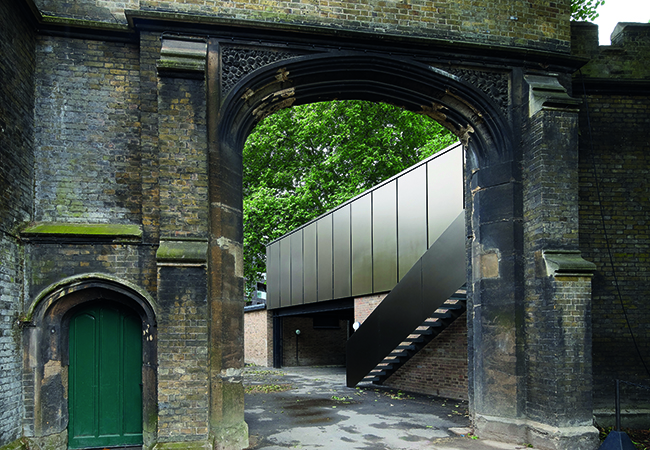
Old and new: The ASHPs (above, right) are behind a metal screen mounted on a platform raised above the ground (above, left), at the back of the palace
The three heat pumps are housed in a new energy centre in a yard at the back of the palace, which previously served as a car park and bin store. They are hidden behind a metal screen mounted on a platform raised above the ground, to maintain the parking spaces. Clarke describes it as ‘one of the most beautiful energy centres I’ve ever done’. Adjacent to this is a new electrical substation. ‘The heat pumps are now the most power-hungry things on site, so locating them adjacent to the incoming power supply makes complete sense,’ adds Clarke.
Policing the rainwater systems
The climate resilience of the palace’s rainwater system and its ability to cope with storm flows was investigated.
The project was fortunate to have the Metropolitan Police headquartered in an adjacent building. According to Clarke, the service was keen to practise flying its new drones and asked if it could do so above the palace grounds.
A deal was agreed whereby the police had to follow a flight path that traced the route of the rainwater guttering, which they had to video. Arup then used the footage to modify some of the roof falls, and to add drainage outlets and downpipes where problems were highlighted.
Clarke says the palace makes use of a wide variety of rainwater-harvesting technologies ‘to demonstrate what could be done with the Church’s wider estate. Systems vary in sophistication, from a water butt to a more elaborate harvesting system that processes the rainwater for use in flushing toilets in the main entertaining areas’.
The new energy centre is connected to the palace by heating mains routed through and around the archaeology buried in one of the courtyards. Archaeological studies revealed walls and traces of former buildings, all of which had to be carefully documented and protected.
‘You dig, you find the archaeology, then you work out the best route around it,’ says Clarke. To minimise the size of the trench, the connecting pipes were manufactured and pre-insulated off site as a single unit sized to fit the route precisely.
Once inside the Blore building, the heating flow and return were run in an existing 600mm-deep trench beneath the floor of the vaulted, ground-floor corridor. From here, branch pipework rises up, mostly in existing risers, to the second-floor guest bedrooms.
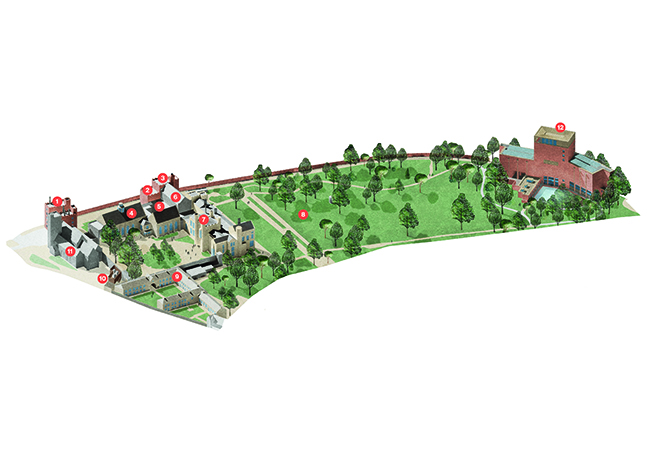
Pick ‘n’ mix: The Lambeth Palace site contains buildings of varying ages and various architectural styles
‘We tried to route the new pipework discreetly using existing risers, notches in joists and holes in the floorboards,’ explains Clarke. Where additional risers were required, they were created in sections of the building that had been bomb damaged, because ‘the heritage had already been lost’, says Clarke.
New radiators were installed. At 50oC flow and 45oC return, the heating temperatures from the ASHP are lower than the 82oC/71oC flow and return provided by the palace’s old gas boilers. New cast iron replacement radiators were installed, sized appropriately for the lower-temperature heating circuit. The old cast iron radiators were sold for architectural salvage.
As well as supplying the phase one works, the ASHPs provide heat for areas of the palace that will be refurbished in subsequent phases, such as the Victorian cottages and Tudor gatehouse. In these areas, existing heat emitters will remain in place, with the heating circuits serving them hydraulically separated by a new heat exchanger.
Arup had to estimate what the heat output would be from the existing emitters now being served by the lower-temperature heat pump circuit. It found that some emitters were capable of providing sufficient heat to keep a space comfortable, while others were not. ‘For some occupied spaces, we had to supplement existing emitters with electric heating to keep occupants comfortable on very cold days,’ Clarke explains.
There was a lot of discussion about the number and location of the PVs, which had to be hidden from sight, but which also had to avoid being shaded by Lambeth Palace’s towers and other features. ‘We settled on an area of panels hidden behind the crenellations of the parapet wall of the Blore Building,’ says Arup’s Edward Clarke. (Read about the PV installation at King’s College Chapel, Cambridge, ‘Renewing tradition’, CIBSE Journal, December 2024, p26, bit.ly/CJDec24.)
Additional areas of PVs are planned for later phases of the project, including on the roofs of the Victorian cottages, which, Clarke says, ‘are not as historically important as the main palace’. These roofs are not currently capable of supporting the weight of the PVs, so installation has been scheduled for later in the project, when the roofs are due for replacement.
‘In advance of their installation, we’ve provided the infrastructure to harvest the power from these PVs and deliver it to the main building when battery storage will be installed,’ explains Clarke.
‘The output from the Blore Building PVs is used instantaneously by the palace, but when the larger PV array is fitted onto the cottages, and the battery is installed, we’ll have the option to peak lop electric demand.’
[/well]
The phase one works were completed at the end of June and the building is in the process of being handed over. ‘We’re working with the contractor to monitor how systems are performing by checking BMS data, which is how we now know our estimate for airtightness was too conservative – the palace is actually much more airtight then we’d hoped,’ Clarke says.
The project’s mix of pragmatism and ambition has, according to the Archbishop of Canterbury’s website, resulted in the palace’s annual CO2 emissions dropping from 647,000kg to 233,000kg under phase one. Emissions are set to fall to 81,000kg when all proposed works and subsequent phases are complete. Offsetting will be used for the remaining emissions to enable the project to reach net zero.