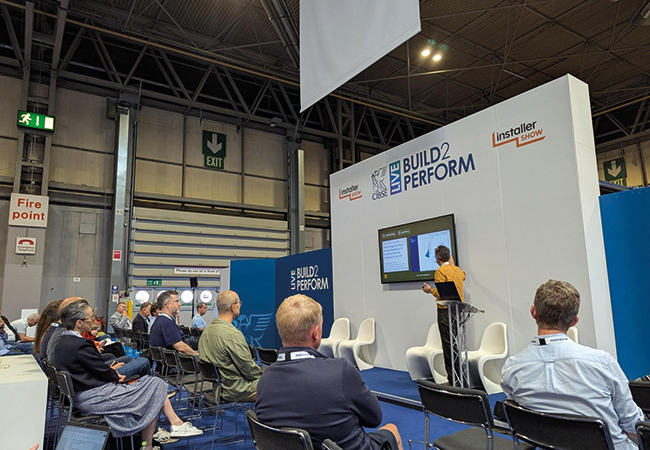
CIBSE hosted Build2Perform at the InstallerShow for the first time
The InstallerSHOW, held at Birmingham’s NEC from 24 to 26 June, welcomed thousands of attendees from across the building services sectors.
A key addition to this year’s event was the CIBSE Build2Perform theatre, a stage packed with technical insight, CPD-accredited talks and real-world challenges, featuring sessions on heat networks, heat interface units, refrigerants, HVAC strategies, and retrofits.
With the UK experiencing two heat waves in June, the presentation on water scarcity, by Introba senior public health engineer Amanda Stanley FSoPHE, was timely. With Met Office 2025 maps showing rainfall well below average, she predicted that this year could match the drought of 2022, or even 1976, when communities relied on standpipes for drinking water.
To conserve water, Stanley said tighter regulations, alongside better education and more infrastructure repairs, were required. She cited figures from Thames Water showing that new homes were using an average of 145 litres per person per day – 35 litres more than design-stage calculations. (Approved Document G of the Building Regulations sets the default standard at 125 l/p/d.)
Stanley – who is on the steering committee for the Good Homes Alliance’s guide on Water efficiency and reuse in housing, which is being launched this month – called for water neutrality and outlined three steps to achieving this: reduce use, through efficient devices and smart metering; reuse, through rainwater and greywater harvesting and treatment; and offset any remaining use.
Joshua Bird, founder of Rethink Buildings, talked about the challenge of fitting heat pumps in some buildings. He said that issues, such as high temperature demands, limited electrical capacity, noise, and space constraints often complicate retrofits.
However, he believes that ‘every building can support a heat pump if properly assessed’. Using tools, such as flow sensors and
real-time data, Bird showed how oversizing can be avoided, saving both cost and space. His key message was: ‘Listen to the building.’
Joel Callow, founding director at Beyond Carbon, introduced a new toolkit to assess thermal comfort, natural daylight and Passivhaus performance metrics simultaneously. Using Rhino 3D, Grasshopper and Ladybug Tools, the toolkit helps designers to respond to evolving schemes in real time, without sacrificing performance in any one area. Callow said assessing criteria in isolation can result in poor outcomes – such as a Passivhaus building with insufficient daylight – requiring costly fixes.
The show’s keynote featured energy minister Miatta Fahnbulleh, who was speaking after the Spending Review and confirmation of £13.2bn for the Warm Homes Plan. Focusing on the £1.3bn for the next wave of the Social Housing Decarbonisation Fund, she said that fuel poverty levels remain unchanged in a decade. ‘The job is clear,’ Fahnbulleh said. ‘We must massively increase the number of upgrades happening over the next four years.’
Addressing the politicisation of green policies, she added: ‘Some political parties think net zero is too expensive. I see this with sorrow and sadness. Even if you don’t believe in net zero, you should believe in energy security.’ She urged decoupling from gas, saying: ‘We have a duty and must bring energy bills down for good