
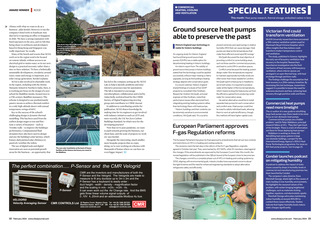
COMMERCIAL HEATING, COOLING AND VENTILATION SPECIAL FEATURES This month: Heat pump research, thermal storage, embodied carbon in fans Ground source heat pumps able to preserve the past Historic England says technology is viable for historic buildings An ongoing study for Historic England has found that ground source heat pumps (GSHPs) are a viable option for decarbonising heating in historic buildings. An interim report from The viability of ground source heat pumps in historic buildings stated that the technology could be applied successfully without major heating or fabric upgrades, as long as the buildings heating strategy aligned with conservation goals. In a recent webinar, Historic England shared findings of a study of five GSHP projects by consultant Max Fordham. Researcher Andrew McQuatt, principal engineer at Max Fordham, noted that performance issues often stemmed from integrating existing heating systems rather than technology flaws with heat pumps. Historic buildings and their contents can be extremely sensitive to environmental conditions, McQuatt said. Its crucial to prevent extremes and rapid swings in relative humidity (RH) that can cause damage. Heat pumps are ideal as the temperatures that make them efficient avoid rapid RH swings. McQuatt discussed the dual objective of providing comfort to some building areas, such as those used for commercial purposes, and heat to control RH in sensitive spaces. Conflicts arise because the heating system design water-flow temperatures required to maintain appropriate humidity levels are often lower than those needed for comfort. McQuatt said if a heat pump is installed to serve both areas, it is required to produce water at the higher of the two temperatures, which means locking the heat pump out from the efficiency gained from producing cooler water for conservation areas. He said an alternative would be to install separate heat pumps for each conservation and comfort area. Heat pumps could then be sized to satisfy individual loads, allowing them to work at optimal efficiency, though this method will have higher capital costs. European Parliament approves F-gas Regulation reforms The European Parliament has given its final approval to amendments that set out new controls and restrictions on HFCs in heating and cooling systems. The revisions mark the last step in the reform of the EU F-gas Regulation, originally agreed in October last year. They were backed by 457 MEPs, while 92 members voted against the changes. If the amendments are approved by the European Council later this month, the revised legislation will be published in the Official Journal of the European Union to become law. The changes commit to a complete phase-out of HFCs in heating and cooling systems by 2050, aligning with environmental goals. Industry bodies have expressed concerns about the tight timeline and the need for enhanced engineering standards to adopt alternative refrigerants safely and efficiently. Victorian find could transform ventilation McGill University researchers have uncovered a 19th-century ventilation system used for Montreals Royal Victoria Hospital, which offers insights that they believe could transform modern temperature control and ventilation. The study, published in iScience, highlights the early use of buoyancy ventilation heat recovery in the hospital. Researchers launched an investigation into the fluid mechanics of heat recovery with buoyancy ventilation, where interior spaces are arranged in an open thermal loop, with heat exchange through partition walls. The findings challenge the assumption that heat recovery is a 20th-century invention. By revamping this lost technique, researchers suggest it is possible to lessen the need for extensive ductwork and fans, achieving heat recovery through partition walls and floors. Commercial heat pumps need more limelight The co-author of a new guide to retrofitting large heat pumps says there needs to be more focus on non-domestic heat pumps. Commercial heat pumps are a hidden problem, said Dr Peter Mallaburn, principal research fellow at UCL. They dont get much of the limelight. There is a lack of information out there for those deploying heat pumps. Mallaburn is working on Annex 60: Retrofitting heat pump systems in large non-domestic buildings, a project for the International Energy Agencys (IEAs) Heat Pump Technologies programme. For more on IEA heat pump projects, turn to page 25. Condair launches podcast on mitigating humidity A podcast to address the impact of static issues caused by drops in humidity levels in commercial and manufacturing premises has been launched by Condair. The companys sales director, Dave Marshall-George, sheds light on the causes of static buildup in low-humidity environments. He highlights the seasonal nature of the problem, with winter bringing heightened challenges, such as materials sticking together, repulsion, and electrostatic sparks. Marshall-George advocates maintaining indoor humidity at around 45% RH to combat these issues effectively. Studies indicate that higher humidity levels reduce static charges significantly. www.cibsejournal.com February 2024 23 CIBSE Feb 24 pp23 Specials News.indd 23 26/01/2024 17:23