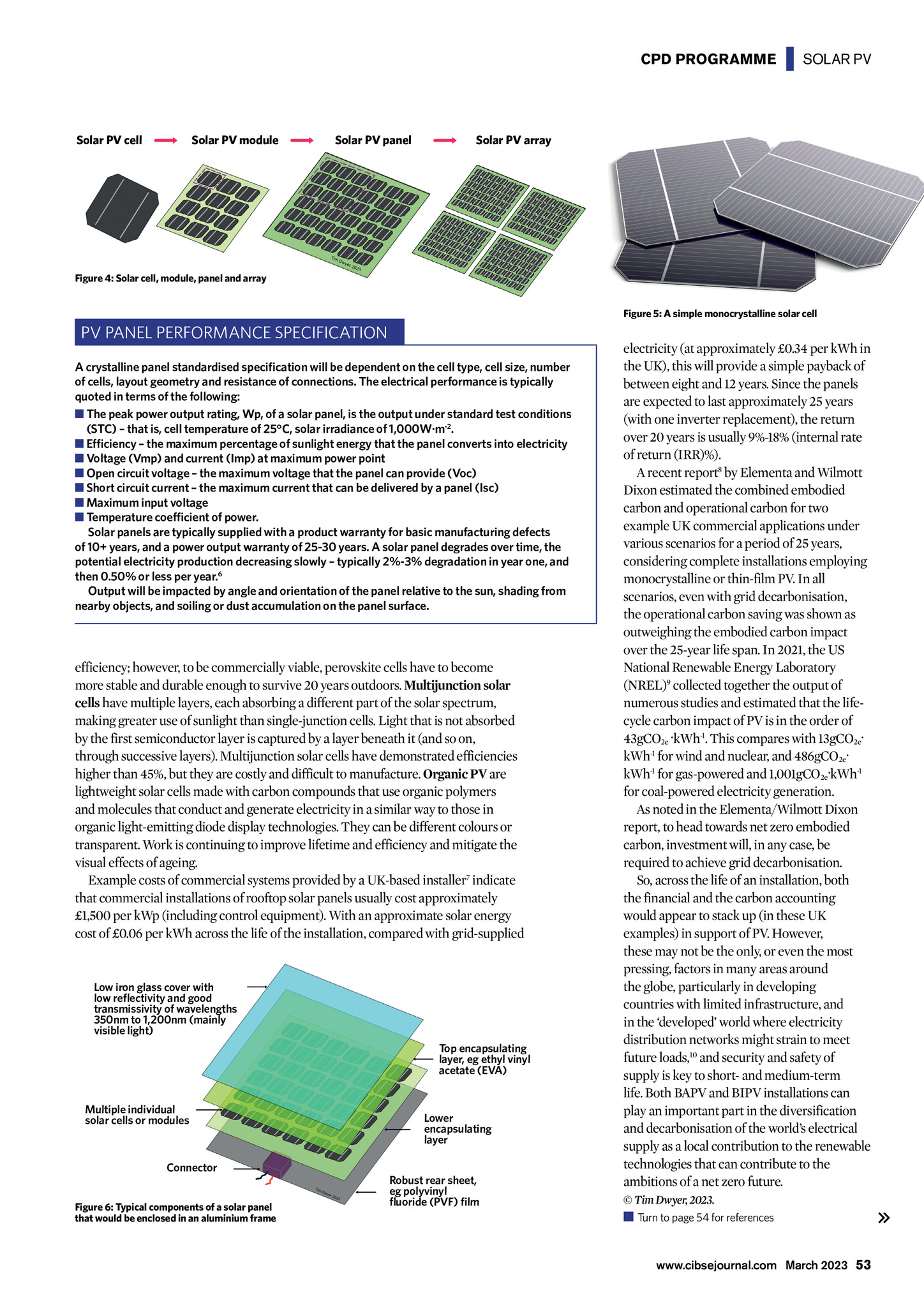
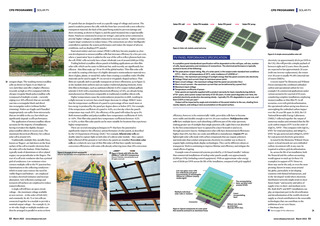
CPD PROGRAMME Solar PV cell Solar PV module Solar PV panel | SOLAR PV Solar PV array Figure 4: Solar cell, module, panel and array Figure 5: A simple monocrystalline solar cell PV PANEL PERFORMANCE SPECIFICATION A crystalline panel standardised specification will be dependent on the cell type, cell size, number of cells, layout geometry and resistance of connections. The electrical performance is typically quoted in terms of the following: The peak power output rating, Wp, of a solar panel, is the output under standard test conditions (STC) that is, cell temperature of 25C, solar irradiance of 1,000W.m-2. Efficiency the maximum percentage of sunlight energy that the panel converts into electricity Voltage (Vmp) and current (Imp) at maximum power point Open circuit voltage the maximum voltage that the panel can provide (Voc) Short circuit current the maximum current that can be delivered by a panel (Isc) Maximum input voltage Temperature coefficient of power. Solar panels are typically supplied with a product warranty for basic manufacturing defects of 10+ years, and a power output warranty of 25-30 years. A solar panel degrades over time, the potential electricity production decreasing slowly typically 2%-3% degradation in year one, and then 0.50% or less per year.6 Output will be impacted by angle and orientation of the panel relative to the sun, shading from nearby objects, and soiling or dust accumulation on the panel surface. efficiency; however, to be commercially viable, perovskite cells have to become more stable and durable enough to survive 20 years outdoors. Multijunction solar cells have multiple layers, each absorbing a different part of the solar spectrum, making greater use of sunlight than single-junction cells. Light that is not absorbed by the first semiconductor layer is captured by a layer beneath it (and so on, through successive layers). Multijunction solar cells have demonstrated efficiencies higher than 45%, but they are costly and difficult to manufacture. Organic PV are lightweight solar cells made with carbon compounds that use organic polymers and molecules that conduct and generate electricity in a similar way to those in organic light-emitting diode display technologies. They can be different colours or transparent. Work is continuing to improve lifetime and efficiency and mitigate the visual effects of ageing. Example costs of commercial systems provided by a UK-based installer7 indicate that commercial installations of rooftop solar panels usually cost approximately 1,500 per kWp (including control equipment). With an approximate solar energy cost of 0.06 per kWh across the life of the installation, compared with grid-supplied Low iron glass cover with low reflectivity and good transmissivity of wavelengths 350nm to 1,200nm (mainly visible light) Top encapsulating layer, eg ethyl vinyl acetate (EVA) Multiple individual solar cells or modules Connector Figure 6: Typical components of a solar panel that would be enclosed in an aluminium frame Lower encapsulating layer Robust rear sheet, eg polyvinyl fluoride (PVF) film electricity (at approximately 0.34 per kWh in the UK), this will provide a simple payback of between eight and 12 years. Since the panels are expected to last approximately 25 years (with one inverter replacement), the return over 20 years is usually 9%-18% (internal rate of return (IRR)%). A recent report8 by Elementa and Wilmott Dixon estimated the combined embodied carbon and operational carbon for two example UK commercial applications under various scenarios for a period of 25 years, considering complete installations employing monocrystalline or thin-film PV. In all scenarios, even with grid decarbonisation, the operational carbon saving was shown as outweighing the embodied carbon impact over the 25-year life span. In 2021, the US National Renewable Energy Laboratory (NREL)9 collected together the output of numerous studies and estimated that the lifecycle carbon impact of PV is in the order of 43gCO2e .kWh-1. This compares with 13gCO2e. kWh-1 for wind and nuclear, and 486gCO2e. kWh-1 for gas-powered and 1,001gCO2e.kWh-1 for coal-powered electricity generation. As noted in the Elementa/Wilmott Dixon report, to head towards net zero embodied carbon, investment will, in any case, be required to achieve grid decarbonisation. So, across the life of an installation, both the financial and the carbon accounting would appear to stack up (in these UK examples) in support of PV. However, these may not be the only, or even the most pressing, factors in many areas around the globe, particularly in developing countries with limited infrastructure, and in the developed world where electricity distribution networks might strain to meet future loads,10 and security and safety of supply is key to short- and medium-term life. Both BAPV and BIPV installations can play an important part in the diversification and decarbonisation of the worlds electrical supply as a local contribution to the renewable technologies that can contribute to the ambitions of a net zero future. Tim Dwyer, 2023. Turn to page 54 for references www.cibsejournal.com March 2023 53