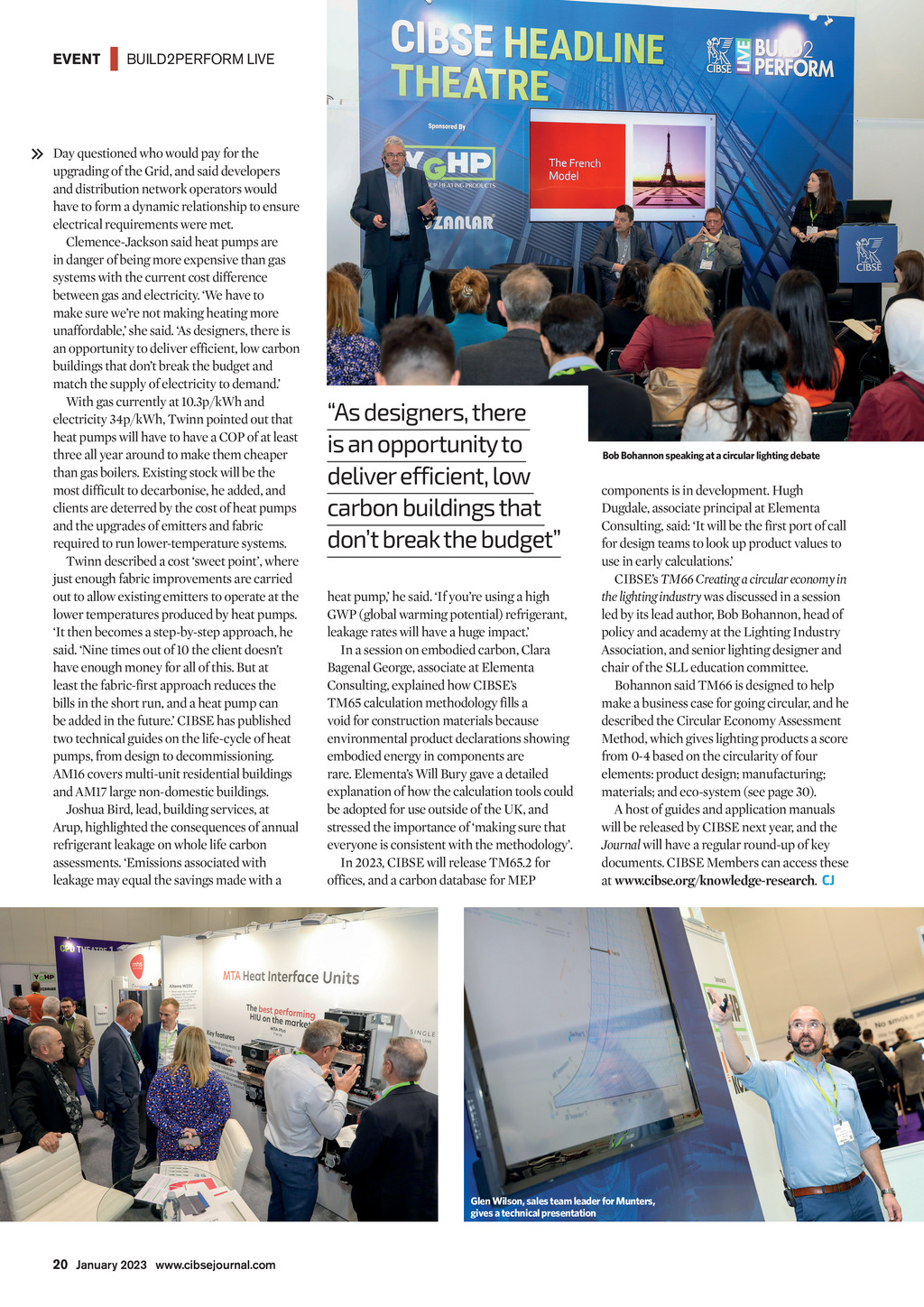



EVENT | BUILD2PERFORM LIVE Day questioned who would pay for the upgrading of the Grid, and said developers and distribution network operators would have to form a dynamic relationship to ensure electrical requirements were met. Clemence-Jackson said heat pumps are in danger of being more expensive than gas systems with the current cost difference between gas and electricity. We have to make sure were not making heating more unaffordable, she said. As designers, there is an opportunity to deliver efficient, low carbon buildings that dont break the budget and match the supply of electricity to demand. With gas currently at 10.3p/kWh and electricity 34p/kWh, Twinn pointed out that heat pumps will have to have a COP of at least three all year around to make them cheaper than gas boilers. Existing stock will be the most difficult to decarbonise, he added, and clients are deterred by the cost of heat pumps and the upgrades of emitters and fabric required to run lower-temperature systems. Twinn described a cost sweet point, where just enough fabric improvements are carried out to allow existing emitters to operate at the lower temperatures produced by heat pumps. It then becomes a step-by-step approach, he said. Nine times out of 10 the client doesnt have enough money for all of this. But at least the fabric-first approach reduces the bills in the short run, and a heat pump can be added in the future. CIBSE has published two technical guides on the life-cycle of heat pumps, from design to decommissioning. AM16 covers multi-unit residential buildings and AM17 large non-domestic buildings. Joshua Bird, lead, building services, at Arup, highlighted the consequences of annual refrigerant leakage on whole life carbon assessments. Emissions associated with leakage may equal the savings made with a As designers, there is an opportunity to deliver efficient, low carbon buildings that dont break the budget heat pump, he said. If youre using a high GWP (global warming potential) refrigerant, leakage rates will have a huge impact. In a session on embodied carbon, Clara Bagenal George, associate at Elementa Consulting, explained how CIBSEs TM65 calculation methodology fills a void for construction materials because environmental product declarations showing embodied energy in components are rare. Elementas Will Bury gave a detailed explanation of how the calculation tools could be adopted for use outside of the UK, and stressed the importance of making sure that everyone is consistent with the methodology. In 2023, CIBSE will release TM65.2 for offices, and a carbon database for MEP Bob Bohannon speaking at a circular lighting debate components is in development. Hugh Dugdale, associate principal at Elementa Consulting, said: It will be the first port of call for design teams to look up product values to use in early calculations. CIBSEs TM66 Creating a circular economy in the lighting industry was discussed in a session led by its lead author, Bob Bohannon, head of policy and academy at the Lighting Industry Association, and senior lighting designer and chair of the SLL education committee. Bohannon said TM66 is designed to help make a business case for going circular, and he described the Circular Economy Assessment Method, which gives lighting products a score from 0-4 based on the circularity of four elements: product design; manufacturing; materials; and eco-system (see page 30). A host of guides and application manuals will be released by CIBSE next year, and the Journal will have a regular round-up of key documents. CIBSE Members can access these at www.cibse.org/knowledge-research. CJ Glen Wilson, sales team leader for Munters, gives a technical presentation 20 January 2023 www.cibsejournal.com CIBSE Jan23.indb 20 03/01/2023 11:12